Every day at Wild Heart Wildlife Foundation, wild animals arrive needing help.
Some are tiny orphans who should still be with their mothers. Some are injured. Some have been displaced, confiscated, or surrendered after being kept by people who could no longer care for them. Some arrive frightened, exhausted and barely hanging on.
And every single one of them needs more than a moment of rescue.
They need food. They need medication and veterinary care. They need warmth, shelter, rehabilitation, specialised care and time. Most importantly, they need someone willing to keep fighting for them until they are ready to return to the wild.
That is where Wild Heart Warriors come in.
What is a Wild Heart Warrior?
Wild Heart Warriors are the people who choose to stand beside us through monthly giving.
A monthly contribution may seem small on its own, but together, our Warriors create something incredibly powerful: reliable support that allows us to plan, prepare and continue caring for the animals who depend on us.
Because wildlife rescue doesn't happen only when we have the funds available.
The animals don't wait for the next fundraiser.
They don't wait for the next donation.
They arrive when they arrive.
And when they do, we need to be ready.
Your monthly gift becomes part of their journey
Your support helps provide the everyday essentials that keep our wildlife rehabilitation work going — from food and specialist diets to medical supplies, veterinary care, enclosure maintenance and the countless practical costs involved in giving an animal a second chance.
It helps us care for the baby who has lost its mother.
The injured animal who needs weeks or months to heal.
The wild soul who has forgotten what freedom feels like.
And ultimately, it helps us reach the moment we work towards every day:
the moment when we can open the door and let them go.
We are Wild Heart Warriors - Will you stand with us?
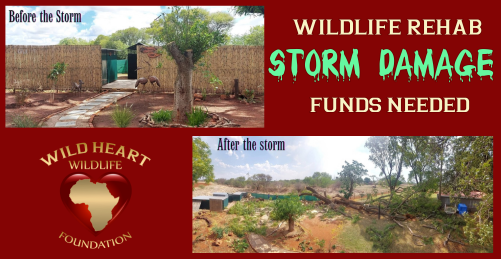
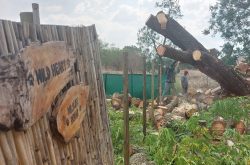
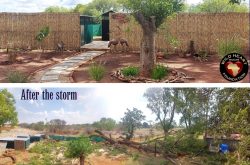
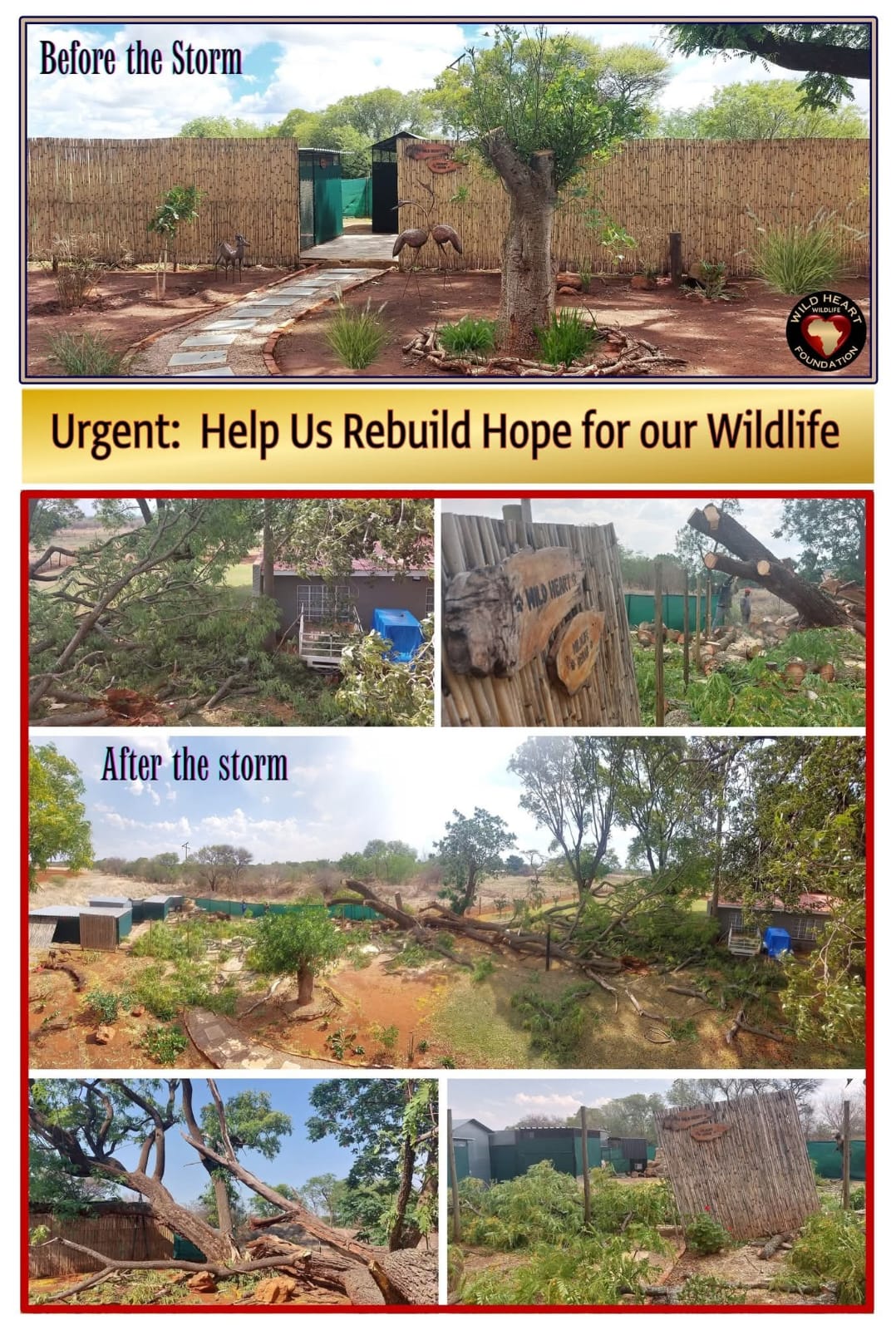
Our Wildlife Rehab Centre has been severely damaged by a storm and we are in urgent need of your support.
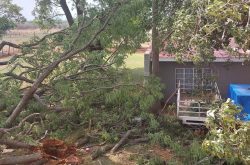
A severe storm has struck our facility, causing a massive tree to fall dangerously close to our ICU section. The other half of the tree crashed into our rehab enclosure area, forcing us to evacuate all the animals from the outdoor rehab space. Every cage had to be manually relocated, putting immense strain on both our staff and the animals.
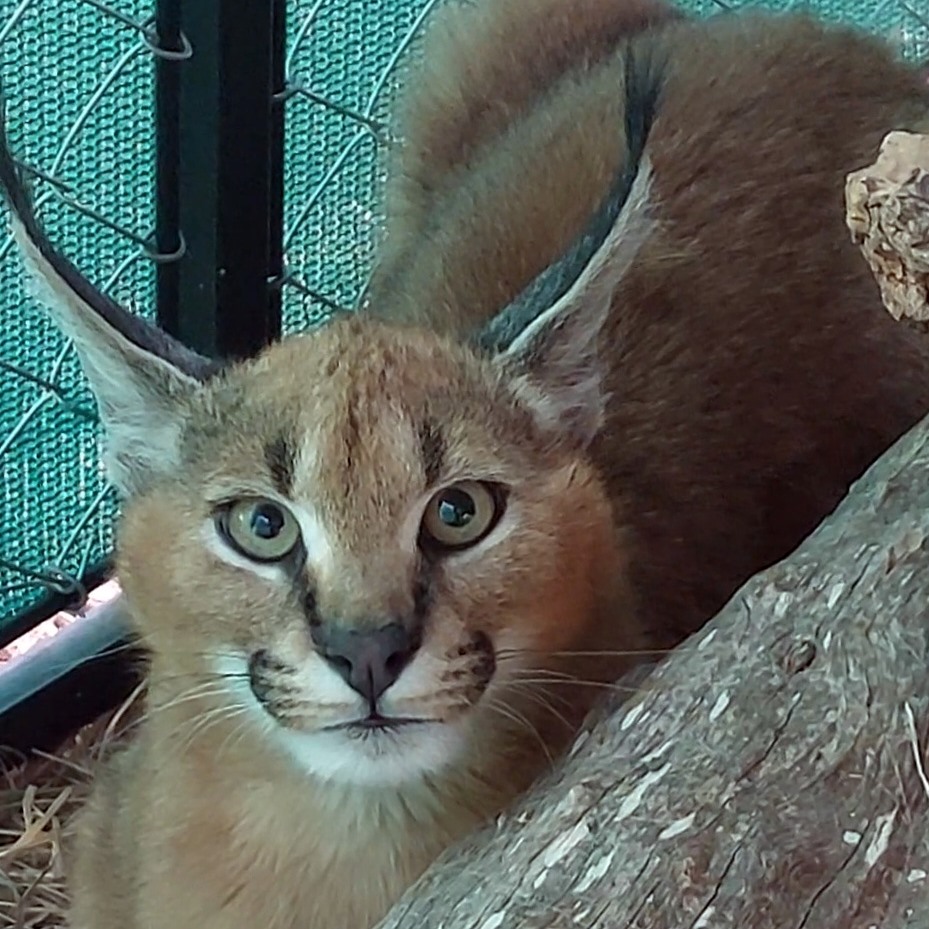
One of our truly wild animals, an adult Caracal, had to be caught by hand as there was no time to arrange sedation, and she was moved to a temporary enclosure. All the rehab animals are safe, but sadly, a wild Pearl-spotted Owlet died when her nest was destroyed by a falling tree.
The tree damaged our main water supply and the water point to the Rehab area, cutting off water to all the animals and disrupting the power supply. It also caused further damage to the concrete slab, bamboo screen fencing, and exterior fencing in the rehab area.
It completely wrecked our food garden for the animals. We had to call in an emergency tree felling company to handle the dangerously unstable part of the tree, which turned out to be very expensive due to the high risk involved, and there's still a lot more to do. Other trees also pose a threat and need to be taken care of.
This situation has pushed our resources to the limit, leaving us exhausted and overwhelmed. We were gearing up to launch a fundraiser for baby season, but this emergency has become our top priority.
We urgently need support to:
- Repair the boundary and screen fences
- Restore water access
- Rebuild damaged rehab infrastructure
- Make the area safe again for animals and staff
- Prepare for incoming wildlife during baby season
- Replant the food garden
- Relocate the cages back once the slab is safe
- Get emergency shade cover for the enclosures now exposed in full sun
Join us in rebuilding the safe haven these creatures rely on. We appreciate any support.
We estimate the total cost of restoration to be between $5,000 and $10,000. (Although we are based in Limpopo Province, South Africa, amounts are in Dollars because a lot of our supporters are from the USA, and frankly, in Rands the totals are just too overwhelming). So far, we've paid $500 to the tree fellers but had to halt their work due to insufficient funds.
Wild Heart Wildlife Foundation is a registered NPO and Section 18A(1)(a) PBO and runs a fully permitted Wildlife Rescue and Rehabilitation Center, accredited by the NSPCA, near Naboomspruit in Limpopo Province, South Africa.
---------------------
We take in injured and orphaned indigenous wildlife with the goal of rehabilitating them for release back into the wild. Please support our work to help wildlife. We cannot do it without you.
Adopt a Barn Owl Chick – Become a Wildlife Guardian
Adopt a Barn Owl Chick – Become a Wildlife Guardian
Wild Heart Wildlife Foundation is offering a unique opportunity for compassionate individuals to become Wildlife Guardians to eight very special Barn Owl chicks currently in our care.
Recently rescued after being found abandoned or compromised, these eight chicks — named Sleepy, Angel, Snowflake, CJ, Heart, Pegasus, Blossom and Spirit — range in age from just 2 to 5 weeks old. They are healthy, growing rapidly, and showing a strong appetite. They have already begun swallowing whole chicks and are preparing to transition to a diet of mice and other yummy, natural foods.
Angel, Snowflake, CJ, Pegasus, and Spirit are still available for adoption!
While they will remain under the professional care of our team at the Wild Heart Wildlife Foundation Rehabilitation Clinic, we are seeking eight dedicated Wildlife Guardians to sponsor their care during their entire rehabilitation journey.
What Does Adoption Mean?
By adopting one of our Barn Owl chicks, you’ll be directly supporting:
• Species-appropriate food and dietary enrichment
• Safe, quiet housing and enclosure development
• Regular health checks and veterinary care when needed.
• Flight training and natural behaviour development in preparation for release
Each adoption helps give these orphaned Owls a second chance at life in the wild where they belong.
Adoption Details
• Adoption Duration: Until they are ready for release
• Adoption Fee: $150(US) (+-ZAR 2500) per owl chick
Recognition: Wildlife Guardians will receive:
• A personalised digital adoption certificate
• Updates and photos during the rehabilitation process
• A special mention on our social media platforms (optional)
We are currently looking for eight Guardians – one for each chick. You may also adopt as a family, school group, or business.
Why Your Support Matters:
Without their parents, these young Owls depend entirely on us. Your support ensures they grow strong, confident, and wild — ready to reclaim their rightful place in nature. Ethical conservation starts with compassion, and through adoption, you become a part of their journey from vulnerable fluff balls to independent nocturnal hunters.
Ready to Adopt? To become a Wildlife Guardian or learn more, please contact:
Paul Roy Oxton: 072 478 1808
Carina Crayton (WhatsApp): 083 588 3550
Wild Heart Wildlife Foundation is a registered NPO and Section 18(a)(1)(a) PBO, operating a fully permitted Wildlife Rescue and Rehabilitation Centre near Crecy, Naboomspruit, Limpopo Province, South Africa. We take in injured and orphaned indigenous wild animals with the goal to rehabilitate them for eventual release back into the wild.
Together, we can give Sleepy, Angel, Snowflake, CJ, Heart, Pegasus, Blossom and Spirit the wild and free future they deserve.
#WHWF #WildHeart #EthicalConservation #RescueRehabRelease #WildAndFree #wildheartwildlifefoundation
Heart – The Soft Explorer
Heart is sweet and steady, with a quiet spirit and a gaze that always seems to be searching the horizon. Not the first to the food bowl, and doesn’t compete yet simply waits for the moment to arrive, then gently steps forward. What sets this little one apart is the curiosity of the outside world, often found slightly away from the group, peeking at the trees and sky. There’s a dreamer inside this little owl, with a soft presence like a breeze through feathers. Heart is the heartbeat of calm in the chaos of the nest.
Spirit – The Feathered Whisper
Spirit is quiet, shy. Just two weeks old, Spirit prefers to hide near the older owlets, where one can disappear into softness and silence. This little one eats gently, listens carefully, and keeps distance, not out of fear, but caution. Spirit is still learning that this world, this place, and the Wild Hearts that are around create a safe haven. But every day, is a day a little closer to freedom. We believe that within this soft little fluffy feathery being is a bold owl waiting to emerge. Spirit may be small and arrived here all alone yet has a bright light glowing from within.
Sleepy – The Dreamer That’s Now Wide Awake
Sleepy got the name for a reason – in the beginning, this little one could hardly keep its eyes open between feeds. But those days are long gone! Now, one of the most alert little owlets in the group, with a healthy appetite and a newfound confidence. Sleepy doesn’t hesitate to step forward at mealtime. This fiercely protective owl is small but spirited, with a heart that’s learning how to be bold. Watching this little one wake up to the world has been pure magic.
Angel – The Soft-Spoken Sidekick
Angel is gentle, loyal, and always just a wing-length away from Pegasus. The bond they share is something special, and Angel seems to take on the role of keeping things tidy, especially when there’s food involved. With a calm presence and a thoughtful nature, often seen making sure no snack goes uneaten. There’s something angelic in the way this little one moves, soft and steady, with eyes full of wonder. Angel may be small, but is already showing signs of a wise soul, the kind of owl who makes the Owl world feel a little safer.
CJ – The Wonder-Wiggler
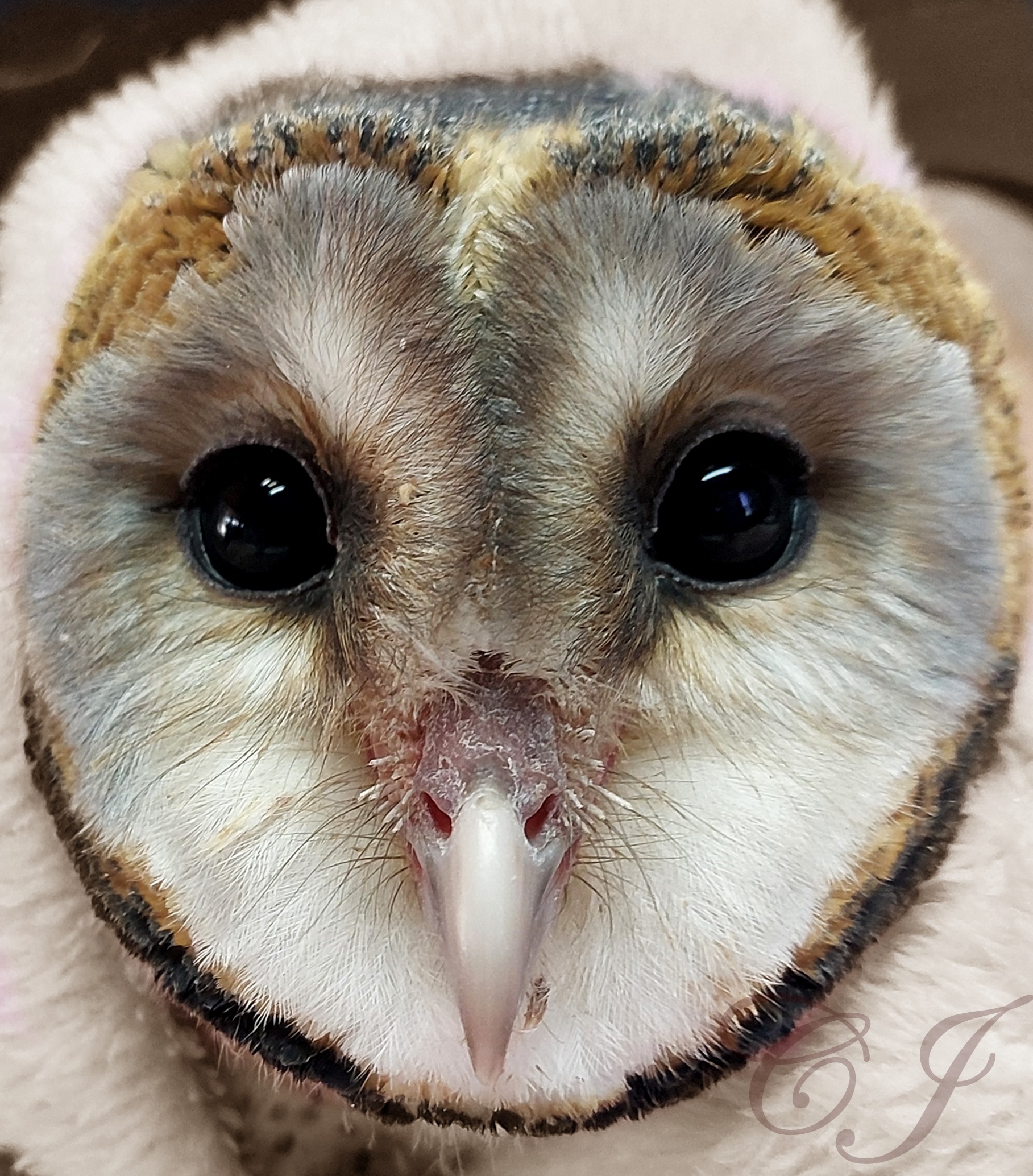
CJ is the little one who listens with the whole fluffy body. When a new sound stirs the air, CJ tilts the head, wiggles the downy belly, and steps closer with wide-eyed curiosity. Polite and patient, never pushy and always seems to be trying to understand the world around. CJ’s tiny movements are full of wonder, and the gentle approach has quickly made this little one a favourite among the carers. CJ reminds us of the quiet joy found in learning, and the bravery it takes to step forward even on the tiniest feet.
Pegasus – The Watchful
Pegasus is the eldest owlet in our care, and carries that title with quiet pride. Calm and reserved, this little one prefers to hang back, keeping a gentle watch over the younger ones like a feathery guardian. Not rushed to eat and takes time, choosing patience over fuss. Trust doesn’t come quickly for Pegasus, but when it does, it’s a gift. There’s wisdom already in these wide eyes, and a deep sense of protection in such a small, soft body. Pegasus reminds us that strength can be silent, and love can be shown simply by being near.
Snowflake – The Tiny Thunderclap
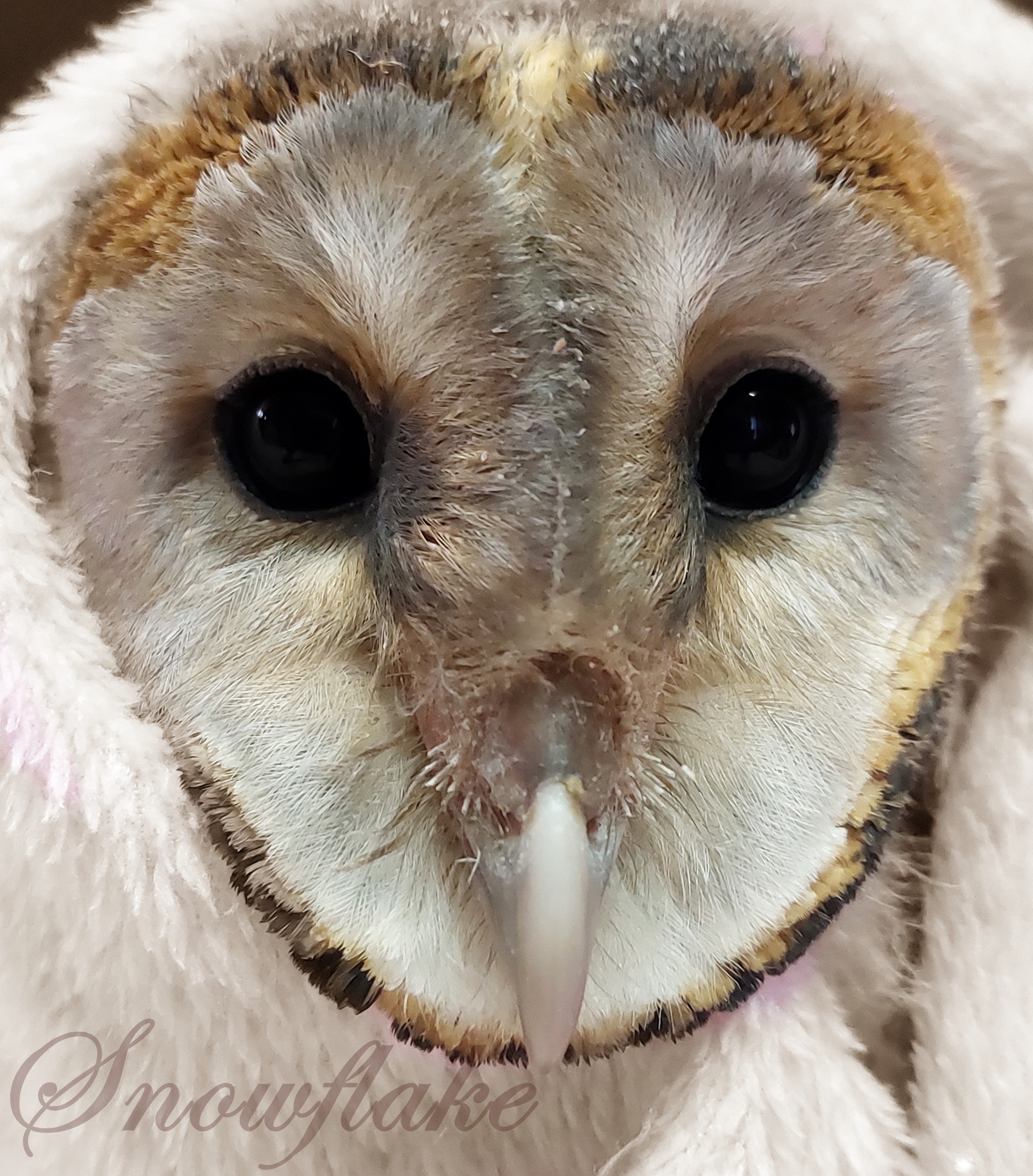
Snowflake is the smallest from the one nest, but you’d never guess that from this little ones attitude. This pint-sized powerhouse has a voice that could wake the whole bush and is not afraid to use it when food is on the line. Bold, cheeky, and absolutely unstoppable, Snowflake will chirp, pounce, and even swipe a snack right out from under a bigger owl’s beak. But behind all that sass is a wildly healthy, thriving baby owl with a huge appetite for life. Snowflake may be tiny, but this little one is all owl and a whole lot of noise!
Blossom – The Little Miracle
Blossom came to us as a tiny, ball of fluff – barely more than a whisper of feathers and hope. Too young to regulate her own warmth, she still snuggles into the backs of the bigger owlets, finding safety in their softness. But don’t be fooled this little one has a huge appetite and a will to grow that’s written into every little chirp. Watching Blossom feed is like watching a flame flicker to life. Blossom is from a different nest, but found a place here, a tiny miracle in motion and a future that will blossom.
ADOPTED OWLS
Sleepy and Blossom have been adopted by Lee and Bernice Nicholson - Thank you!
Heart has been adopted by Debbie Pahl - Thank You!
Spirit has been adopted by A E Roodt - Thank You!
UPCOMING ADOPTION PROGRAMMES
Wildlife Guardians, stay connected with us to learn more about our upcoming animal adoption programs. Adopt a Bushbaby or Tortoise and make a difference today! Show your support for the animals at the Wild Heart Wildlife Foundation Rehabilitation Centre and be part of something truly special.
Wildlife Guardians, stay connected with us to learn more about our upcoming animal adoption programs. By virtually adopting animals identified for the program, you can make a difference! Show your support for the animals at the Wild Heart Wildlife Foundation Rehabilitation Centre and be part of something truly special - their journey to Freedom!
This list will be updated as soon as an animal has been identified as suitable for virtual adoption 🙂
For more information, whatsapp Carina Crayton at +27835883550 or email wildheartwf.info@gmail.com
ADOPT A BUSHBABY - No adoptions available at the moment 🙁
Adopt a Bushbaby – Become a Wildlife Guardian
Adopt a Bushbaby – Become a Wild Heart Wildlife Guardian
UPDATE: All Bushbabies ready for adoption have been kindly adopted by Gerhard & Vera Eastes - THANK YOU!
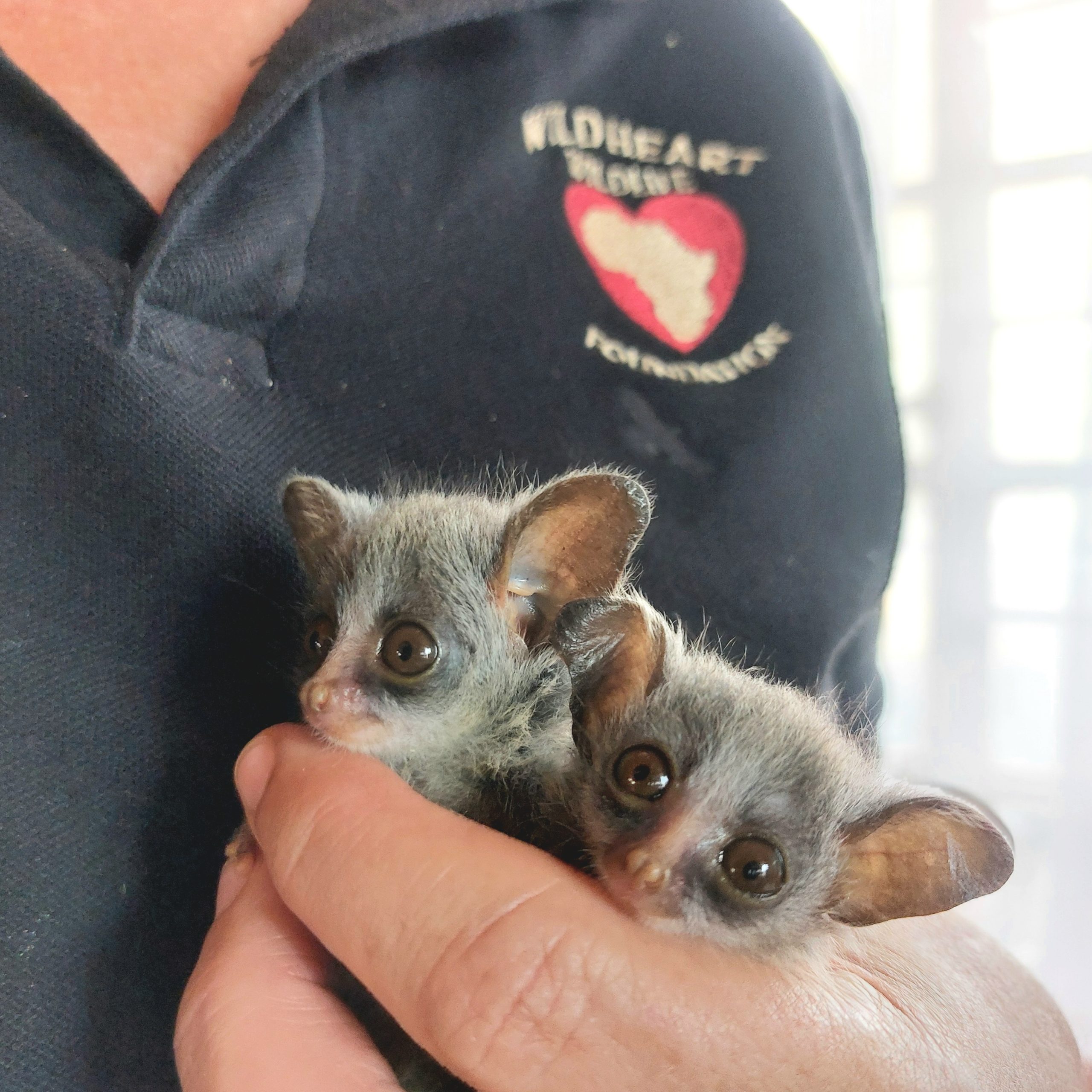
Wild Heart Wildlife Foundation is offering a unique and heartwarming opportunity for wildlife lovers to become Wildlife Guardians to four remarkable Bushbabies (Galago moholi) currently in our care.
Each of these special little primates — Mickey, Minnie, AJ, and Baby — has their own story of survival. Rescued from the illegal pet trade or found orphaned and alone, they are now undergoing rehabilitation with the hope of returning to their wild home where they belong.
We are seeking four dedicated Guardians to help sponsor their ongoing care, rehabilitation, and eventual release back into the wild.
Meet the Bushbabies:
Mickey – Once an illegal pet with a broken tail and a weathered soul. Though small and scruffy, he is deeply affectionate once he trusts you. Lives for crickets.
Minnie – Another victim of the illegal pet trade. Big-boned, cautious, and fiercely protective of the younger ones. She has a soft spot for Superworms (but not humans… which is perfect).
AJ – Wild at heart, AJ was surrendered after being kept rescued from danger and then kept as a pet. Fiercely independent and curious, bonded to Mickey. Crickets are not on the menu — worms only, please.
Baby – A wild orphan with a sharp mind and zero tolerance for humans. Bonded with Minnie. Adventurous, always the first to explore. Eats just about anything (even odd plants).
What Does Adoption Mean?
By adopting one of our bushbabies, you’ll be directly supporting:
• Specialised diet (including insects like crickets, superworms, native plant forage, supplements and acacia gum)
• Natural enclosure enrichment and habitat simulation
• Veterinary care, health monitoring, and all injury management
• Social bonding and behaviour preparation for wild reintegration
Your sponsorship gives them the strength, confidence, and wild instincts they need to survive in their natural environment. They deserve to be wild and free.
• A personalised digital adoption certificate, and a detailed fact sheet in a later email.
• Updates throughout the rehabilitation journey via emails, photos etc.
• Optional shoutout on our social media platforms
You may adopt as an individual, family, business, or school group - and yes, you’re welcome to adopt more than one!
Why Your Support Matters
Bushbabies are sensitive, intelligent, and highly social nocturnal animals. Those raised in captivity often become frustrated and start biting, lose their natural instincts and suffer trauma. With your help, these four survivors are getting a second chance - not just at life, but at freedom.
Every adoption makes a real difference in ethical, compassionate wildlife rehabilitation.
Ready to Adopt?
To become a Wildlife Guardian or for more information, please contact:
Wild Heart Wildlife Foundation is a registered NPO and Section 18A(1)(a) PBO, operating a fully permitted Wildlife Rescue and Rehabilitation Centre near Crecy, Naboomspruit, Limpopo Province, South Africa.
Let’s give Mickey, Minnie, AJ, and Baby the wild heart and free future they were born for.
ADOPT AN OWL - No adoptions available at the moment 🙁
Adopt a Barn Owl Chick – Become a Wildlife Guardian
Adopt a Barn Owl Chick – Become a Wildlife Guardian
Wild Heart Wildlife Foundation is offering a unique opportunity for compassionate individuals to become Wildlife Guardians to eight very special Barn Owl chicks currently in our care.
Rescued after being found abandoned or compromised, these eight chicks — named Sleepy, Angel, Snowflake, CJ, Heart, Pegasus, Blossom and Spirit — ranged in age from just 2 to 5 weeks old when they came in. They are healthy, growing rapidly, and showing a strong appetite. They are already transitioned to a diet of mice, chicks and other yummy, natural foods.
Angel & Pegasus are still available for adoption!
While they will remain under the professional care of our team at the Wild Heart Wildlife Foundation Rehabilitation Clinic, we are still seeking two dedicated Wildlife Guardians to sponsor their care during their entire rehabilitation journey.
What Does Adoption Mean?
By adopting one of our 2 remaining Barn Owl chicks, you’ll be directly supporting:
• Species-appropriate food and dietary enrichment
• Safe, quiet housing and enclosure development
• Regular health checks and veterinary care when needed.
• Flight training and natural behaviour development in preparation for release
Each adoption helps give these orphaned Owls a second chance at life in the wild where they belong.
Adoption Details
• Adoption Duration: Until they are ready for release
• Adoption Fee: $150(US) (+-ZAR 2500) per owl chick
Recognition: Wildlife Guardians will receive:
• A personalised digital adoption certificate
• Updates and photos during the rehabilitation process
• A special mention on our social media platforms (optional)
We are currently looking for two more Guardians – we already have one for each of six adopted chicks. You may also adopt as a family, school group, or business.
Why Your Support Matters:
Without their parents, these young Owls depend entirely on us. Your support ensures they grow strong, confident, and wild — ready to reclaim their rightful place in nature. Ethical conservation starts with compassion, and through adoption, you become a part of their journey from vulnerable fluff balls to independent nocturnal hunters.
Ready to Adopt? To become a Wildlife Guardian or learn more, please contact:
Paul Roy Oxton: 072 478 1808
Carina Crayton (WhatsApp): 083 588 3550
Wild Heart Wildlife Foundation is a registered NPO and Section 18A(1)(a) PBO, operating a fully permitted Wildlife Rescue and Rehabilitation Centre near Crecy, Naboomspruit, Limpopo Province, South Africa. We take in injured and orphaned indigenous wild animals with the goal to rehabilitate them for eventual release back into the wild.
Together, we can give Sleepy, Angel, Snowflake, CJ, Heart, Pegasus, Blossom and Spirit the wild and free future they deserve.
#WHWF #WildHeart #EthicalConservation #RescueRehabRelease #WildAndFree #wildheartwildlifefoundation
Heart – The Soft Explorer
Heart is sweet and steady, with a quiet spirit and a gaze that always seems to be searching the horizon. Not the first to the food bowl, and doesn’t compete yet simply waits for the moment to arrive, then gently steps forward. What sets this little one apart is the curiosity of the outside world, often found slightly away from the group, peeking at the trees and sky. There’s a dreamer inside this little owl, with a soft presence like a breeze through feathers. Heart is the heartbeat of calm in the chaos of the nest.
Spirit – The Feathered Whisper
Spirit is quiet, shy. Just two weeks old, Spirit prefers to hide near the older owlets, where one can disappear into softness and silence. This little one eats gently, listens carefully, and keeps distance, not out of fear, but caution. Spirit is still learning that this world, this place, and the Wild Hearts that are around create a safe haven. But every day, is a day a little closer to freedom. We believe that within this soft little fluffy feathery being is a bold owl waiting to emerge. Spirit may be small and arrived here all alone yet has a bright light glowing from within.
Sleepy – The Dreamer That’s Now Wide Awake
Sleepy got the name for a reason – in the beginning, this little one could hardly keep its eyes open between feeds. But those days are long gone! Now, one of the most alert little owlets in the group, with a healthy appetite and a newfound confidence. Sleepy doesn’t hesitate to step forward at mealtime. This fiercely protective owl is small but spirited, with a heart that’s learning how to be bold. Watching this little one wake up to the world has been pure magic.
Angel – The Soft-Spoken Sidekick
Angel is gentle, loyal, and always just a wing-length away from Pegasus. The bond they share is something special, and Angel seems to take on the role of keeping things tidy, especially when there’s food involved. With a calm presence and a thoughtful nature, often seen making sure no snack goes uneaten. There’s something angelic in the way this little one moves, soft and steady, with eyes full of wonder. Angel may be small, but is already showing signs of a wise soul, the kind of owl who makes the Owl world feel a little safer.
CJ – The Wonder-Wiggler
CJ is the little one who listens with the whole fluffy body. When a new sound stirs the air, CJ tilts the head, wiggles the downy belly, and steps closer with wide-eyed curiosity. Polite and patient, never pushy and always seems to be trying to understand the world around. CJ’s tiny movements are full of wonder, and the gentle approach has quickly made this little one a favourite among the carers. CJ reminds us of the quiet joy found in learning, and the bravery it takes to step forward even on the tiniest feet.
Pegasus – The Watchful
Pegasus is the eldest owlet in our care, and carries that title with quiet pride. Calm and reserved, this little one prefers to hang back, keeping a gentle watch over the younger ones like a feathery guardian. Not rushed to eat and takes time, choosing patience over fuss. Trust doesn’t come quickly for Pegasus, but when it does, it’s a gift. There’s wisdom already in these wide eyes, and a deep sense of protection in such a small, soft body. Pegasus reminds us that strength can be silent, and love can be shown simply by being near.
Snowflake – The Tiny Thunderclap
Snowflake is the smallest from the one nest, but you’d never guess that from this little ones attitude. This pint-sized powerhouse has a voice that could wake the whole bush and is not afraid to use it when food is on the line. Bold, cheeky, and absolutely unstoppable, Snowflake will chirp, pounce, and even swipe a snack right out from under a bigger owl’s beak. But behind all that sass is a wildly healthy, thriving baby owl with a huge appetite for life. Snowflake may be tiny, but this little one is all owl and a whole lot of noise!
Blossom – The Little Miracle
Blossom came to us as a tiny, ball of fluff – barely more than a whisper of feathers and hope. Too young to regulate her own warmth, she still snuggles into the backs of the bigger owlets, finding safety in their softness. But don’t be fooled this little one has a huge appetite and a will to grow that’s written into every little chirp. Watching Blossom feed is like watching a flame flicker to life. Blossom is from a different nest, but found a place here, a tiny miracle in motion and a future that will blossom.
ADOPTED OWLS
Sleepy and Blossom have been adopted by Lee and Bernice Nicholson - Thank you!
Heart has been adopted by Debbie Pahl - Thank You!
Spirit has been adopted by A E Roodt - Thank You!
CJ and Snowflake have been adopted by Rob Melville - Thank You!
If you're the kind of person who would like to see what your money does, this is a great option for you! We've set up several Wish Lists on the Takealot platform, so you can see what appeals to you and have it sent to our door.
If you'd like to support us by directly purchasing something from our Takealot Wish List for delivery to our Rehab Gate, please follow these instructions. We've also tested this method with several of our supporters abroad, and it works extremely well! (Keep in mind that the exchange rate is around ZAR18 to USD1 at the moment, or ZAR22 = GBP1).
STEP 1. Click on the relevant wish list link, and 'heart' the items you are interested in.
Step 3. Select item(s) from Wishlist(s), and place in shopping cart.
Step 4. Proceed to check-out.
Step 5. Click on Deliver my Order:
Step 6. Fill out the next screen as follows:
Step 7. It will ask for additional address details. Copy and paste this text into the search bar: 7R88+WF Kalfontein, South Africa
Step 8. You can now pay for your order via your chosen method. Remember thatUSD 1 = +- ZAR 18,so an item of ZAR 5000 will cost approximately USD 275. and so on.
In a precedent-setting ruling, captive Lion breeder Gert Claasen was found guilty on contravention of The Animals Protection Act 71 of 1962. Although only sentenced to a fine of R4000 or 12 months imprisonment, this is the first successful case relating to the welfare of captive bred Lions in South Africa. The NSPCA regards it as a major win that the Steilfontein Farm owner has been brought to book for the cruel, negligent confinement of these animals. This sets a precedent for every related cruelty case that will be brought before the courts.
Inspections reveal horrendous cruelty
The case was brought before the court by the NSPCA, following joint inspections with the Provincial Nature Conservation (DESTEA: Economic, Small Business Development, Tourism and Environmental Affairs) and DFFE (the Department of Forestry, Fisheries and Environment). The officials’ 2022 visit to Claasen’s Steilfontein Farm, based in the area of the town Petrus Steyn in the Free State Province, revealed animal welfare concerns with regards to the captive conditions of several feline predators. Follow-up inspections revealed that conditions had worsened, with no fresh drinking water available, rotting meat and faeces left in the enclosures, fly infestations, obvious signs of malnourishment, paralysis and pain without veterinary intervention, and lack of shelter – all of which contravene the Act. (Animal Protection Act 71 of 1962). Over-crowding within the enclosures further contravened the permit conditions.
Breeding breaking the brand
In South Africa, the captive bred Lion industry is alive and well, with around 8000 captive Lions being bred on more than 500 farms. It is not currently illegal, provided that the breeders do have the correct permits in place. A high-level panel on the management, breeding, hunting, trade and handling of Elephants, Lions, Leopards, and Rhinos, in May 2021, recommended the formation of a ministerial task team – to identify and recommend pathways for captive lion owners to exit their business voluntarily, with the premise that it would be outlawed in the future. This task team was formed by DFFE Minister Barabara Creecy, in December 2022.
Wild Lion Conservation in South Africa is mostly funded by Eco-tourism, which has been negatively impacted by the sordid captive Lion industry. The captive Lion industry therefore poses a risk to the sustainability of Lion Conservation in South Africa. The panel recommended the closure of the captive breeding sector and its resultant trade in body parts.
Breeding for greed
Captive bred Lions are exploited at every level. The Lionesses are breeders, producing an ongoing litter of cubs, which are removed from her within a few days at most. These cubs get petted and fed and photographed by unsuspecting tourists and paying volunteers who believe the lies that these cubs had been abandoned in the wild. The next stage is walking with lions, which once again generates millions of Rands (for the owner – not for Lion Conservation). Once the Lions have become too big to walk with safely, they are shipped to hunting farms for trophy / canned hunts. The last level of exploitation is the selling of the body parts, skin, teeth, bones – nothing escapes the greed. The cycle starts all over again.
Many South African organizations, including Wild Heart Wildlife Foundation, have been actively involved in bringing awareness of and seeking solutions for the captive breeding industry to South African citizens and the rest of the world. Because it is such a lucrative industry, with one Lion able to earn its owner over ZAR 2million during a relatively short lifespan, it is challenging for small NGOs to compete with the funding these breeders have at their disposal.
Small steps to success
It’s easy to become disheartened and overwhelmed by what is happening with captive lions in South Africa, so we have to focus on the successes. And although the fine imposed on Gert Claasen is laughable, it still resulted in him now having a criminal record, and being instructed by the Judge to warn the other captive lion breeders. While fighting against the horrific captive lion breeding industry in South Africa, as long as every step leads to the same outcome, small steps are fine too.
Written by Carina Crayton (Co-Founder Wild Heart Wildlife Foundation)
For years, Wild Heart Wildlife Foundation has been working to raise the awareness about the merciless slaughter of these Vanishing Giants, strengthening their protection, and caring for the survivors. Has it all been in vain? It certainly seems like it's over for the Rhinos in the Kruger National Park.
We are customizing an expensive hydraulic operating table for rescued Rhino Babies and you can help! Make a difference by supporting our 8th Annual Xmas Fundraiserfor The Rhino Orphanage here:
Kruger National Park, the world’s greatest refuge for rhinos, is losing them to poaching faster than they’re being born. The park’s last Rhino may already be alive. It’s time to declare an emergency.
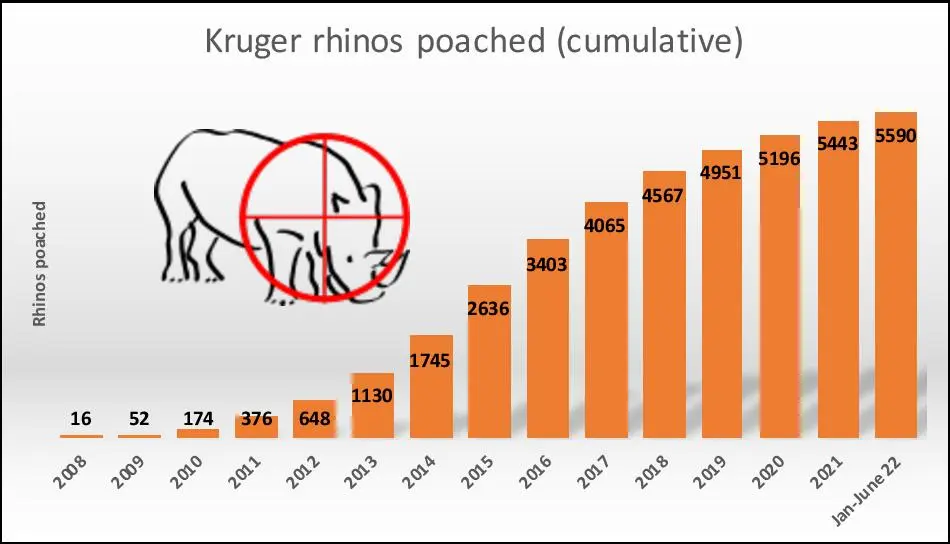
Under the heading Progress, the 2022 SANParks Annual Report has a deeply disturbing and immensely sad target claimed as a success: only 195 rhinos were killed by poachers during 2021 – an average of one every two days. The success, it seems, is that the previous year it was one rhino every 36 hours.
In its reports and pronouncements, SANParks acknowledges poaching problems, but the overall tone is “don’t panic, we’ve got it under control”. They haven’t. Kruger is bleeding rhinos and is in need of sutures – fast.
The Department of Forestry, Fisheries and Environment (DFFE) has disclosed that in the first six months of this year, 82 rhinos were killed in the park. If the trend continues, the year will end up with a kill rate equal to 2021.
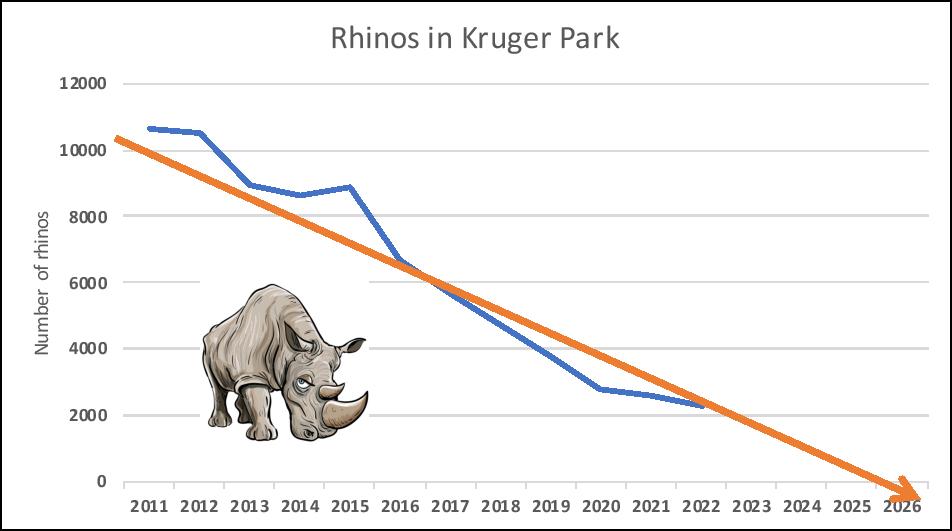
The truth is that unless Kruger does something fast, Rhinos could go extinct in the park within four years. That’s far shorter than the lifespan of most rhinos in Kruger.
Since 2009 – just 13 years – rhino numbers have dropped from 11,420 to 2,458 and this year they will continue to drop. During that time, the number of rhinos poached was double the existing population.
The cumulative numbers are shocking. There’s a good chance that Kruger rhinos are on the way to becoming functionally extinct, as these graphs clearly show.
Where do the problems lie?
What will it take to bend the curve upwards away from zero? The answer can only come from understanding the reasons for the decline.
SANParks will point to forces beyond their control – and they are considerable.
Like a snake eating its own tail, the problem begins and ends with a seemingly insatiable appetite in Asia for rhino horn, which is seen as both a status symbol and cure for various ailments (it isn’t).
This has led to a situation where highly organised international crime syndicates supply weapons and logistics to local middlemen who induce impoverished young men in communities on both sides of the park to poach rhinos.
The park is sandwiched between millions of mostly poor people – Mozambican and South African – with few prospects for employment. It’s fertile ground for poacher recruitment.
Kruger Park also has unfenced borders with a parallel park in Mozambique, but rangers following poachers cannot cross the line.
In his book, Rhino War, written with Tony Park, General Johan Jooste – who was Kruger’s head ranger from 2013 to 2016 – was told by a ranger: “They laughed at us, General. As soon as they crossed the border they stopped and started waving at us, yelling insults. They know we cannot chase after them.”
These issues alone, however, cannot be the sole reason for the precipitous decline of rhinos. There are serious internal problems as well, mostly, says Jooste, to do with ability, capacity, integrity and vision.
Buffet’s cancellation
A retired military officer, Jooste was brought in as head ranger in 2013 as rhino poaching began escalating. Donations formed the backbone of his development strategy and with them he created a highly trained paramilitary force out of the ranger corps. He also brought in high-tech surveillance equipment.
Jooste negotiated a R225-million anti-poaching grant from billionaire Howard Buffett, using it to create an efficient joint command centre to gather and coordinate intelligence against poachers.
Then, in 2016, Buffett cancelled more than half of the grant, citing the absence of a reporting structure with clearly defined roles and lack of internal capacity for project management. Millions were wasted on internal inquiries into this loss.
The collapse of Intensive Protection Zones for rhinos – set up by Jooste during his tenure and funded by Buffett – started coming apart after his departure. They did so, he says, because Kruger and ranger leadership failed “to carry them through and find a way to make them work or come up with workable alternatives”.
It was an “abdication of duty and lack of courage”.
Buffett’s bequest had been received with great fanfare, but evidently not universally within SANParks’ executive ranks.
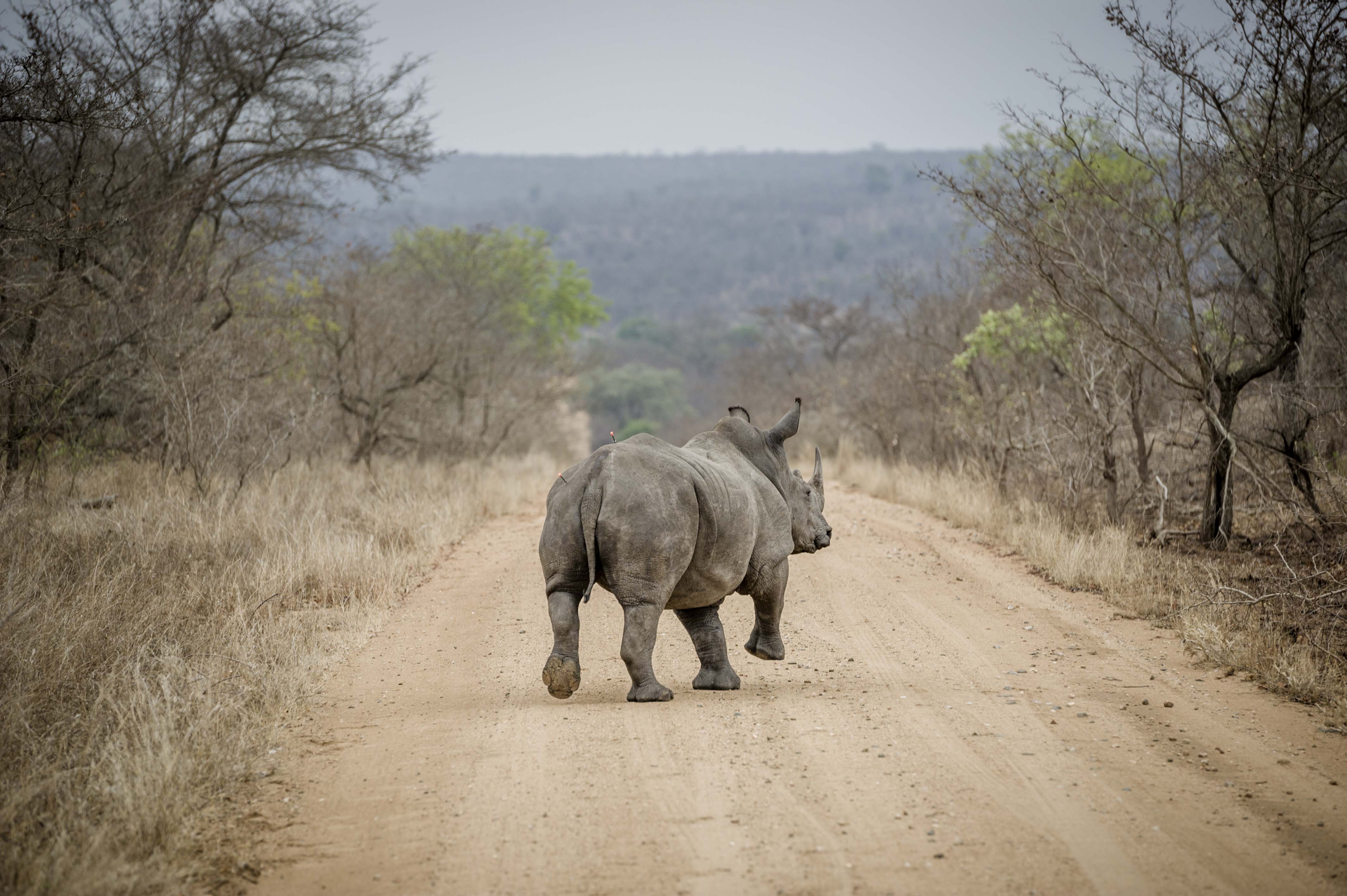
A rhino after it is sedated on October 16, 2014 in the Kruger National Park, South Africa. Photo by Gallo Images / Foto24 / Cornel van Heerden)
Buffett’s generosity was based on his personal regard for Jooste and, according to the book, Rhino War, this rankled with those who didn’t appreciate being beholden to a rich American who had made it clear that his largesse would only be in place as long as Jooste – the white ex-apartheid general – remained at the helm.
Integrity testing
Jooste resigned under circumstances he is not willing to discuss; details of which are largely absent from his book. He alludes to “problems”. The park clearly not only lost necessary funding, but a key strategist in the rhino war. One of the problems, it seems, was integrity testing.
“Members of Exco feel you’re acting outside your mandate in pursuit of corruption after integrity testing,” he was told. Integrity testing was the euphemism for the polygraph testing of Kruger staff. From the outset, Jooste had insisted on this intervention and was the first to subject himself to the process.
Integrity testing was not popular, but Jooste felt it was necessary.
Poachers were paying some rangers to locate rhinos and a few were even involved in actual poaching. These included Rodney Landela, who Jooste had promoted to regional ranger.
Unions were also opposed to polygraph testing and it was suspended during the Covid pandemic. SANParks has undertaken to renew it, but has as yet failed to do so. It is not known whether a proposal for integrity testing was finally submitted to the SANParks board in November.
In his book, Jooste says testing without steps being taken on the results is useless. While Kruger management knows that leaks on rhino locations are coming from staff, they seem to be dragging their heels on making integrity testing happen.
Ranger shortage
Kruger also has a ranger shortage. More than 80 posts were not filled this year despite a commitment to do so obtained by DA shadow minister David Bryant.
They had not been filled for several years. SANParks explained the problem as a budget issue, despite millions being spent of anti-poaching initiatives.
It is unclear and counterintuitive that these posts are not budgeted for and filled as a fundamental step in the poaching war.
Strongholds
Beyond Kruger Park, rhino conservation is another story and is in an intensive planning stage. Although the park has the largest single population of black and white rhinos, around 60% of the national species are in private hands and many others are in national and provincial parks other than Kruger.
According to SANParks’ Annual Report, strongholds beyond Kruger are being constructed, though it doesn’t say how advanced this is or quite how this programme will work. It’s clearly not in the interests of rhino safety to say where they are or will be.
There will be pushback from conservationists. They point out that placing rhinos in private hands has led to the crisis of rhino farming for their horns, which keep “leaking” on to the black market. This fuels both Asian demand and poaching. There’s a fine line between conservation and commercialisation.
In Rhino War, Jooste writes of Kruger: “A decade into the rhino campaign, my overwhelming realisation is that we cannot afford another 10 years like this, even with our successes. We must avoid another ‘runaway train’ situation at all costs.”
If the statistics are anything to go by, that train without brakes has already left the Kruger Park station. DM/OBP
1. Elephants have a specific alarm call that means 'humans'.
2. Rhinoceros horns consist of keratin - just like your fingernails and hair.
3. Giraffes make almost no sounds. Scientists believe that their necks are too long for the airflow across their vocal cords to result in any sound being made.
4. Many herbivore animals chew on bones, including Giraffes, Zebras, Tortoises, and Buffalo. This is to obtain certain essential minerals lacking in their diets.
5. Zebra stripes act as a natural bug deterrent. Apparently the contrasts confuse/dazzle blood-sucking insects to the point where they cannot land on the zebra. Incidentally, a group of Zebras is called a 'Dazzle'
6. Elephants can't jump, probably because they don't need to! They evade predators in other ways.
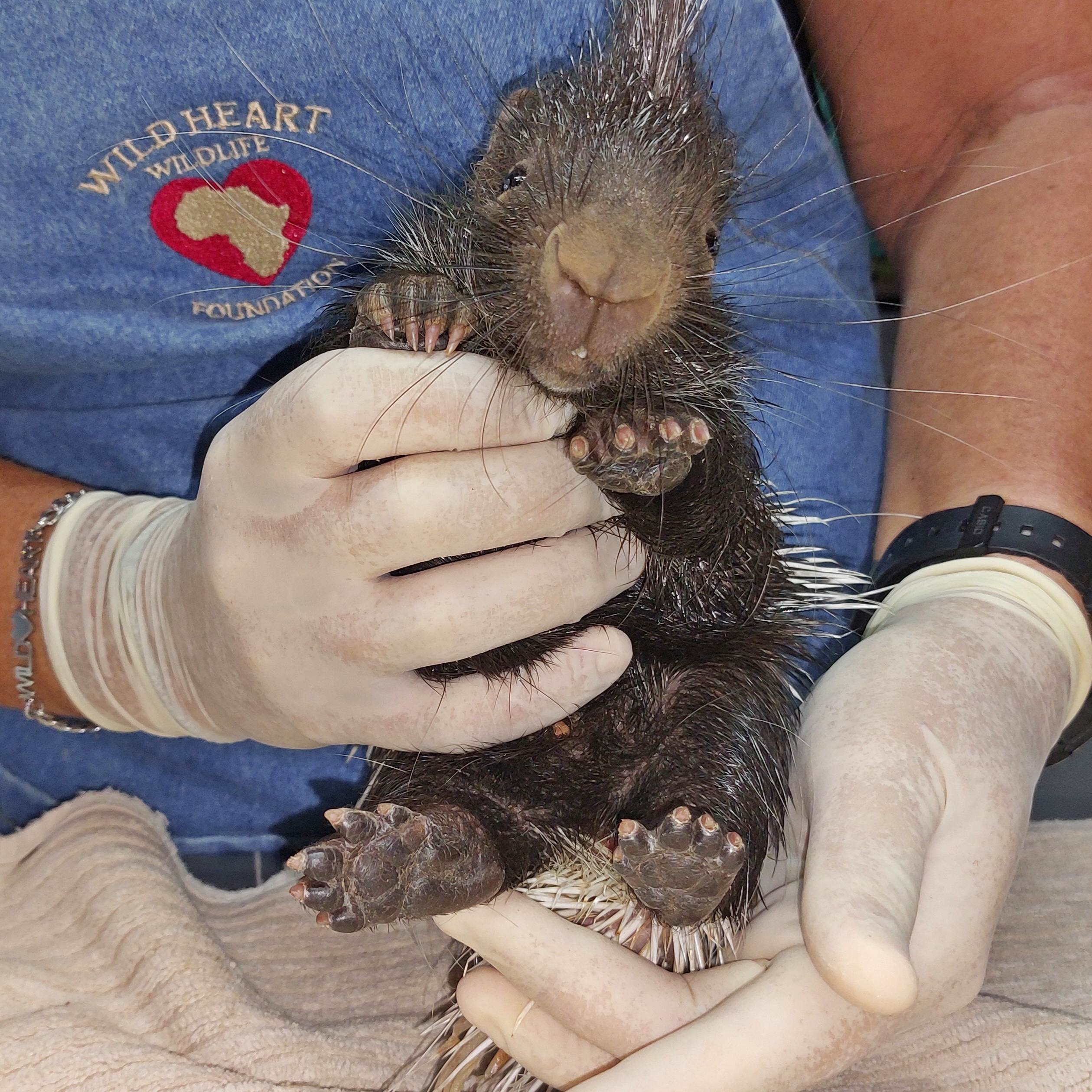
7. Porcupines stomp their feet and growl as a warning to stay away. They also rattle their quills, although they cannot 'shoot' them at a predator.
8. The eye of an ostrich is bigger than its brain. It's not a case of an under-sized brain, but rather of over-sized eyes, allowing ostriches to see threats and food from a great distance.
9. Sea otters use tools like rocks, to smash open snails to eat.
10. Hartebeest run in zig-zag patterns to evade predators.
11. The adult flamingo can only eat when its head is upside down. They filter the water through their bent beaks used upside down to filter feed on tiny plants and organisms in the water.
12. For every human in the world there are one million ants. I think all of mine live at my house.
13. Octopuses can taste with their arms. The arms of an octopus are lined with hundreds of suckers, each of which can act as a taste bud.
14. Sunbirds are the African equivalent of hummingbirds, and they are monogamous - mating for life.
15. Giraffes have black tongues in front, but the back and base of it is pink. Many experts believe that this darker pigment is nature's way of protecting giraffe tongues against ultraviolet rays.
16. The only mammal capable of flight is the bat. Other mammals like the flying squirrel glide, they do not fly.
17. Lionesses do most of the hunting in a pride. Even though females are the primary hunters, male lions can hunt, too. Female lions famously hunt their prey in packs, while male lions have typically been viewed as the lazy recipients of the spoils.
18. Bottle-nosed dolphins are mostly right-handed (right-finned?). Researchers found they favored their right side. It's not just humans that are left or right-handed. Animals also show a clear preference for what scientists call “lateralized behavior.”
19. A group of Rhinos is called a Crash.
20. Elephant Calves such their trunks to comfort themselves, like human babies would suck their thumbs.
21. The collective noun for Owls is a 'Parliament'.
22. Nile Crocodiles can live up to 100 years, but mostly survives up to 80 years maximum.
23. Butterflies taste with their feet. Butterflies don't have tongues, they have a proboscis which many people think of as a tongue but it's more like having your mouth extended into a long tube. They do have some taste buds on their proboscis and some on their antennae as well, but most of the taste buds are focused on their feet.
24. Jonathan (hatched c. 1832), a Seychelles Giant Tortoise (is the oldest known living land animal.
25. Gorillas can catch human colds and other illnesses. Humans and gorillas are about 98 percent identical on a genetic level.
Watch VIDEO here:
26. Ostriches can run faster than horses, and the male ostrich is capable of making a “roaring” noise similar to a lion's roar, adding a hiss with it.
27. A group of Buffalo is called an 'Obstinacy'.
28. Killer Whales experience menopause, like Human Females.
29. A grasshopper can leap 20 times the length of its own body.
30. Owls don't have eyeballs. They have eye tubes or cylinders, rod-shaped eyes that do not move in their sockets as eyeballs do. Instead, owls have to move their bodies or heads in order to look around.
31. There are an estimated 8.7 million species on earth and more than 80% of them are undiscovered. Africa is immensely rich in biodiversity. Its living organisms comprise around a quarter of global biodiversity and it supports the earth's largest intact groups of large mammals, which roam freely in many countries.
32. Wild Dolphins call each other by name. Each dolphin has a 'signature whistle' which is copied by another dolphin during communication, just like you would call someone by their name.
33. Gorillas have been seen dismantling traps set by poachers. Staff at the Dian Fossey Research Center in Rwanda witnessed two 4-year-olds and a teenage mountain gorilla work together to destroy snares.
34. African Buffalo herds display voting behavior, in which individuals register their travel preference by standing up, looking in one direction and then lying back down. Only adult females can vote. Herd movements are guided by majority vote. If the votes were evenly divided between two directions, then the herd separates for the night, grazing at different locations, and reconvenes in the morning.
35. Rhino Calves eat their mothers' dung for digestion development. It helps mature their digestive systems, which at birth do not have the bacteria needed to help digest the grass material that they will feed on for the rest of their lives.
36. Chimpanzees are very intelligent and make all kinds of tools. Like spears to hunt with, and sticks to scratch open a den. They are sophisticated tool users with behaviors including cracking nuts with stone tools and fishing for ants or termites with sticks. These chimpanzees not only use these sticks to fish out their meal, but they in fact build their own 'tool kits' to do so, as observed in the Republic of Congo.
37. Pangolins' only protection mechanism is curling into a ball, but their scales provide good defense against predators. When threatened, pangolins can quickly roll into a ball, protecting their vulnerable undersides. They also deter predators by hissing and puffing, and lashing their sharp edged tails.
38. A Duiker (tiny African antelope) is classified as one of the ten most dangerous antelope to handle, in Africa, due to its razor-sharp horns that can cut through a human's femoral artery in the groin.
39. Porcupines mate for life.
40. A Woodpecker has a long tongue that folds into its skull, and protects its brain from vibration damage as a result of pecking out a nest in a tree. Having its tongue wrapped around the back of its brain doesn't just give a woodpecker somewhere to store a long appendage; it also helps protect the bird's brain from injury during high-speed pecking.
41. Both Black and White Rhino are Grey in colour. Black Rhinos are mostly browsers, while White Rhinos mainly feed on short grass on the ground using their square upper lip. Black Rhinos have a unique looking, pointy upper lip, which they use to grasp and pluck food from trees, bushes and shrubs.
42. Hyenas mark their territory or advertise for a mate by fixing a substance from their anal glands onto grass stalks. This is called 'pasting'.
43. Flamingos are not pink. They are born grey, their diet of brine shrimp and blue green algae contains a natural pink dye called canthaxanthin that makes their feathers pink.
44. A group of Parrots is called a 'Pandemonium'. African Grey Parrots voluntarily help each other to obtain food and perform selfless acts, even with individuals they’re not ‘friendly’ with.
45. A cheetah is the fastest land animal - capable of reaching speeds up to 125km/h (75mph).
46. Meerkat parents train their offspring to hunt scorpions. The parents bring the babies half-dead prey or scorpions with the stinger removed, to teach them how to kill scorpions without getting stung.
47. Nile Crocodiles have the strongest bite of any animal. At 5000 pounds per square inch (psi), that's approximately five times the bite force of a lion and about 30 times that of an average human being.
48. The Shoebill Stork can swallow baby crocodiles whole. Shoebill Storks are masters of patience. They will stand in water, on large patches of grass, and other hiding places for hours on end, just to suddenly lunge at an unsuspecting prey. Their stomachs can digest almost any kind of prey.
49. The Black Mamba is not black in colour; the name derives from its mouth, black inside, and displayed when it feels threatened. Its venom is an extremely potent neuro and cardio-toxic mix, capable of killing a dozen men within an hour. Without proper treatment and anti-venom, the mortality rate is almost 100%.
Official Statement regarding the Giraffe Attack at Kuleni Game Park:
Issued by Wild Heart Wildlife Foundation Management
22 Oct 2022 at 11h30
As reported, a child was killed and her mother gravely injured during an attack by a giraffe at Kuleni Game Park in KZN, on Wednesday.
On Thursday it was widely stated in the International media that the Giraffe had been euthanized. We published an article on social media informing the public about the incident, and sharing the information we had access to at that stage.
During Friday the 21st of October 2022, we were inundated with calls from journalists requesting comments and interviews. In every case, we explained that we are not sure of the exact happenings at the game, and anything said about the actual incident is merely speculation.
Most of the interviews centered around what normally would happen to the animal during such incidents. We went on to explain what would typically happen in situations like this when a human attacks an animal.
We believe that every effort should be made to protect life, whether human or animal, and if it is an animal such as a giraffe attacking a human; it is not a normal occurrence, and there is no reason why the animal would need to be euthanized.
We categorically state that any statements we were quoted in to the contrary are blatantly false, and taken out of context.
While we spend our lives trying to better the lives of the Wildlife we are able to help, we find it incredibly disturbing that supposedly reputable international and local media could report happenings that are simply not true, all for sensationalism, and go one step further by taking our statements and using it out of context. We have been widely misquoted in the media as well.
We apologize for any negative outcomes as a result of what we were led to believe were the facts around this tragic incident.
We thank our loyal supporters who contacted us for clarification about our stance on this sensitive subject.
Once again, we reiterate our condolences to the family of the deceased.
On the R71 outside Gravelotte (Between Gravelotte & Tzaneen), Limpopo, South Africa, you will find the Leydsdorp Baobab. Advertized as being more than 2000 years old, this ancient giant is an impressive sight to behold.
R20 per person gets you into the embrace of this magnificent tree, after completing a simple attendance register.
You have to be quiet in the presence of greatness. The mere thought that this tree might have already been around at 1 A.D. is enough to leave you breathless. You are allowed to hug this tree, and you should, or take the wooden ladder and climb into the crown, and become part of that stillness for a while. Most humans love to destroy irreplaceable things. It is a sobering feeling to be perched in this tree and just value its ancient existence. You should do it.
Ivor Mathias is The Tree's human guardian. He whispers of the legends that surround this living statue. Should you pick a single flower, a lion will eat you. The gravestones in the cemetery of nearby gold-rush ghost-town Leydsdorp bear silent witness to that tale.
The flowers of a Baobab tree bloom only for one night, with their sweet fragrance attracting the bats pollinating the flowers.Baobabs are deciduous (they lose their leaves during the cooler months), and the juvenile leaves differ from those of the adult tree. This gave rise to the belief among some indigenous people that the trees just appear, fully grown, overnight.
Cream of Tartar used to be made from the seeds, but are now produced as a by-product of wine-making. Literally every part of a baobab tree is useful. Just like in The Lion King, it acts as a water reservoir and it can save the lives of animals during a drought, as they chew on the water-rich bark.
The fruits are nutrient-rich, the bark is handy for rope-making and a myriad other purposes.
Over the years the Leydsdorp Baobab had been used as a post office, mortuary, bar, fridge, kitchen and make-shift home. Naturally hollow inside, most baobabs feature a comfortable, constant 22 degrees Celsius interior.
Baobabs form an eco-system all of their own, with certain trees like the Sagole Baobab even hosting a rare colony of mottled spinetail swallows.
Adansonia digitata (Baobab) is one of eight species of Baobabs occurring around the world, also known as upside-down trees.
This giant is 25m tall, with a girth of +-22m, making it one of the biggest Baobabs in South Africa.
If you are anywhere close to the Northern Parts of the Limpopo Province, go and seek out the Baobabs on the list of Champion Trees (Protected Trees in South Africa), but don't forget to hug our Leydsdorp Baobab friend too.


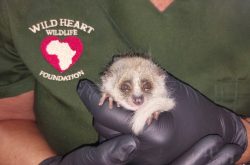
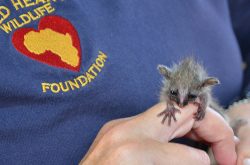









 Mickey – Once an illegal pet with a broken tail and a weathered soul. Though small and scruffy, he is deeply affectionate once he trusts you. Lives for crickets.