50 #FunFacts about #AfricanWildlife:

1. Elephants have a specific alarm call that means 'humans'.
2. Rhinoceros horns consist of keratin - just like your fingernails and hair.
3. Giraffes make almost no sounds. Scientists believe that their necks are too long for the airflow across their vocal cords to result in any sound being made.
4. Many herbivore animals chew on bones, including Giraffes, Zebras, Tortoises, and Buffalo. This is to obtain certain essential minerals lacking in their diets.
5. Zebra stripes act as a natural bug deterrent. Apparently the contrasts confuse/dazzle blood-sucking insects to the point where they cannot land on the zebra. Incidentally, a group of Zebras is called a 'Dazzle'
6. Elephants can't jump, probably because they don't need to! They evade predators in other ways.
7. Porcupines stomp their feet and growl as a warning to stay away. They also rattle their quills, although they cannot 'shoot' them at a predator.
8. The eye of an ostrich is bigger than its brain. It's not a case of an under-sized brain, but rather of over-sized eyes, allowing ostriches to see threats and food from a great distance.
9. Sea otters use tools like rocks, to smash open snails to eat.
10. Hartebeest run in zig-zag patterns to evade predators.
11. The adult flamingo can only eat when its head is upside down. They filter the water through their bent beaks used upside down to filter feed on tiny plants and organisms in the water.
12. For every human in the world there are one million ants. I think all of mine live at my house.
13. Octopuses can taste with their arms. The arms of an octopus are lined with hundreds of suckers, each of which can act as a taste bud.
14. Sunbirds are the African equivalent of hummingbirds, and they are monogamous - mating for life.
15. Giraffes have black tongues in front, but the back and base of it is pink. Many experts believe that this darker pigment is nature's way of protecting giraffe tongues against ultraviolet rays.
16. The only mammal capable of flight is the bat. Other mammals like the flying squirrel glide, they do not fly.
17. Lionesses do most of the hunting in a pride. Even though females are the primary hunters, male lions can hunt, too. Female lions famously hunt their prey in packs, while male lions have typically been viewed as the lazy recipients of the spoils.
18. Bottle-nosed dolphins are mostly right-handed (right-finned?). Researchers found they favored their right side. It's not just humans that are left or right-handed. Animals also show a clear preference for what scientists call “lateralized behavior.”
19. A group of Rhinos is called a Crash.
20. Elephant Calves such their trunks to comfort themselves, like human babies would suck their thumbs.
21. The collective noun for Owls is a 'Parliament'.
22. Nile Crocodiles can live up to 100 years, but mostly survives up to 80 years maximum.
23. Butterflies taste with their feet. Butterflies don't have tongues, they have a proboscis which many people think of as a tongue but it's more like having your mouth extended into a long tube. They do have some taste buds on their proboscis and some on their antennae as well, but most of the taste buds are focused on their feet.
24. Jonathan (hatched c. 1832), a Seychelles Giant Tortoise (is the oldest known living land animal.
25. Gorillas can catch human colds and other illnesses. Humans and gorillas are about 98 percent identical on a genetic level.
Watch VIDEO here:
26. Ostriches can run faster than horses, and the male ostrich is capable of making a “roaring” noise similar to a lion's roar, adding a hiss with it.
27. A group of Buffalo is called an 'Obstinacy'.
28. Killer Whales experience menopause, like Human Females.
29. A grasshopper can leap 20 times the length of its own body.
30. Owls don't have eyeballs. They have eye tubes or cylinders, rod-shaped eyes that do not move in their sockets as eyeballs do. Instead, owls have to move their bodies or heads in order to look around.
31. There are an estimated 8.7 million species on earth and more than 80% of them are undiscovered. Africa is immensely rich in biodiversity. Its living organisms comprise around a quarter of global biodiversity and it supports the earth's largest intact groups of large mammals, which roam freely in many countries.
32. Wild Dolphins call each other by name. Each dolphin has a 'signature whistle' which is copied by another dolphin during communication, just like you would call someone by their name.
33. Gorillas have been seen dismantling traps set by poachers. Staff at the Dian Fossey Research Center in Rwanda witnessed two 4-year-olds and a teenage mountain gorilla work together to destroy snares.
34. African Buffalo herds display voting behavior, in which individuals register their travel preference by standing up, looking in one direction and then lying back down. Only adult females can vote. Herd movements are guided by majority vote. If the votes were evenly divided between two directions, then the herd separates for the night, grazing at different locations, and reconvenes in the morning.
35. Rhino Calves eat their mothers' dung for digestion development. It helps mature their digestive systems, which at birth do not have the bacteria needed to help digest the grass material that they will feed on for the rest of their lives.
36. Chimpanzees are very intelligent and make all kinds of tools. Like spears to hunt with, and sticks to scratch open a den. They are sophisticated tool users with behaviors including cracking nuts with stone tools and fishing for ants or termites with sticks. These chimpanzees not only use these sticks to fish out their meal, but they in fact build their own 'tool kits' to do so, as observed in the Republic of Congo.
37. Pangolins' only protection mechanism is curling into a ball, but their scales provide good defense against predators. When threatened, pangolins can quickly roll into a ball, protecting their vulnerable undersides. They also deter predators by hissing and puffing, and lashing their sharp edged tails.
38. A Duiker (tiny African antelope) is classified as one of the ten most dangerous antelope to handle, in Africa, due to its razor-sharp horns that can cut through a human's femoral artery in the groin.
39. Porcupines mate for life.
40. A Woodpecker has a long tongue that folds into its skull, and protects its brain from vibration damage as a result of pecking out a nest in a tree. Having its tongue wrapped around the back of its brain doesn't just give a woodpecker somewhere to store a long appendage; it also helps protect the bird's brain from injury during high-speed pecking.
41. Both Black and White Rhino are Grey in colour. Black Rhinos are mostly browsers, while White Rhinos mainly feed on short grass on the ground using their square upper lip. Black Rhinos have a unique looking, pointy upper lip, which they use to grasp and pluck food from trees, bushes and shrubs.
42. Hyenas mark their territory or advertise for a mate by fixing a substance from their anal glands onto grass stalks. This is called 'pasting'.
43. Flamingos are not pink. They are born grey, their diet of brine shrimp and blue green algae contains a natural pink dye called canthaxanthin that makes their feathers pink.
44. A group of Parrots is called a 'Pandemonium'. African Grey Parrots voluntarily help each other to obtain food and perform selfless acts, even with individuals they’re not ‘friendly’ with.
45. A cheetah is the fastest land animal - capable of reaching speeds up to 125km/h (75mph).
46. Meerkat parents train their offspring to hunt scorpions. The parents bring the babies half-dead prey or scorpions with the stinger removed, to teach them how to kill scorpions without getting stung.
47. Nile Crocodiles have the strongest bite of any animal. At 5000 pounds per square inch (psi), that's approximately five times the bite force of a lion and about 30 times that of an average human being.
48. The Shoebill Stork can swallow baby crocodiles whole. Shoebill Storks are masters of patience. They will stand in water, on large patches of grass, and other hiding places for hours on end, just to suddenly lunge at an unsuspecting prey. Their stomachs can digest almost any kind of prey.
49. The Black Mamba is not black in colour; the name derives from its mouth, black inside, and displayed when it feels threatened. Its venom is an extremely potent neuro and cardio-toxic mix, capable of killing a dozen men within an hour. Without proper treatment and anti-venom, the mortality rate is almost 100%.
50. Baby porcupines are called porcupettes.
Written & compiled by Carina Crayton
Click HERE to DONATE to #WHWF

Please Share this Article, Page or Post here


WHWF Statement on Giraffe attack

Official Statement regarding the Giraffe Attack at Kuleni Game Park:

Issued by Wild Heart Wildlife Foundation Management
22 Oct 2022 at 11h30

As reported, a child was killed and her mother gravely injured during an attack by a giraffe at Kuleni Game Park in KZN, on Wednesday.

On Thursday it was widely stated in the International media that the Giraffe had been euthanized. We published an article on social media informing the public about the incident, and sharing the information we had access to at that stage.

During Friday the 21st of October 2022, we were inundated with calls from journalists requesting comments and interviews. In every case, we explained that we are not sure of the exact happenings at the game, and anything said about the actual incident is merely speculation.

Most of the interviews centered around what normally would happen to the animal during such incidents. We went on to explain what would typically happen in situations like this when a human attacks an animal.

We believe that every effort should be made to protect life, whether human or animal, and if it is an animal such as a giraffe attacking a human; it is not a normal occurrence, and there is no reason why the animal would need to be euthanized.
We categorically state that any statements we were quoted in to the contrary are blatantly false, and taken out of context.

While we spend our lives trying to better the lives of the Wildlife we are able to help, we find it incredibly disturbing that supposedly reputable international and local media could report happenings that are simply not true, all for sensationalism, and go one step further by taking our statements and using it out of context. We have been widely misquoted in the media as well.

We apologize for any negative outcomes as a result of what we were led to believe were the facts around this tragic incident.

We thank our loyal supporters who contacted us for clarification about our stance on this sensitive subject.

Once again, we reiterate our condolences to the family of the deceased.

* Statement Ends

For more information contact:
Carina Crayton (Co-Founder WHWF)
083 588 3550
Wildheartwf.info@gmail.com
Or
Paul Oxton (CEO/Founder WHWF)
072 478 1808
wildheartwildlife@gmail.com


Please Share this Article, Page or Post here


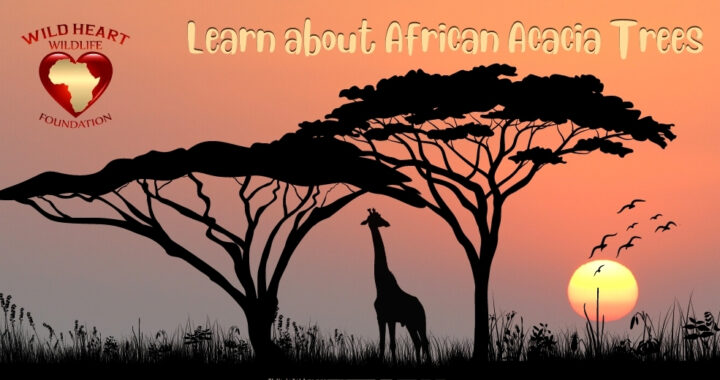
African Acacia Trees – Learn More!

Few trees are as iconic as the flat-topped Acacia on the plains of the African Savannah. On par with the Big 5, these trees instantly evoke nostalgia in those who know them, and will forever be associated with the African Safari.

What’s in a name?

The botanical names of African Acacia trees have been changed in the last decade, from ‘Acacia’ (such as Acacia karroo) to Vachellia (Vachellia karroo), and Senegalia. Despite wide-spread unhappiness in the world of Botany, the common name for these unique trees will always remain ‘Acacia’. As it should. Australian Acacias are still called Acacia spp. Collectively, these species (Acacia, Vachellia, and Senegalia) will still be known as Acacias as a common name. There are around 1000 species of Acacia worldwide, primarily in Australia and Africa.

The iconic, flat-topped African Acacia (Nyanga Flat - Top) is called Vachellia abyssinica.

The dome-shaped Vachellia erioloba, known as the Giraffe Thorn or Camel Thorn tree, is the most recognizable tree in the Kalahari desert, and occurs widely in the drier areas  in Southern Africa. It can grow up to grow up to 18 m tall and live up to 200 years. The tap root can grow up to 60 m, allowing it to access deep ground water sources and live in extremely dry climates.

A Deeper Meaning:

The Acacia is of spiritual significance in that it symbolizes regeneration, perseverance, and integrity. The evergreen nature of this tree denotes the immortality of the human spirit.

The ancient Egyptians made funeral wreathes of Acacia. They believe that Osiris was the first god to be born under the Acacia tree, and all others followed. The Hebrews planted a sprig of evergreen Acacia to mark the grave of a departed friend. Acacias are also mentioned in the Bible, with specific reference to the building of the tabernacle.

A Useful Tree:

Senegalia senegal (Gum Arabic Tree) found in Sudan and the northern Sahara, is the main source of gum arabic, which has been used for over 2,000 years in paints, watercolours, candy, medicines, calico printing, dyeing, and in the making of silk, paper, and cosmetics.

The various species of Acacia were used by early shipbuilders for its durable wood, and today many countries cultivate the trees. Along with the wood being used for furniture, flooring and even weapons and jewellery, the gum is used as an adhesive, for medicine, and even for chewing gum and desserts. Furthermore, the blossom can be used as flavouring, the seeds utilised in sauces and the tannin as a dye. And in Central America, the swollen thorns are made into beautiful necklaces.

In landscaping and gardening, Acacias are often used to control soil erosion in dry and damaged soils. They can be planted as protective hedges, creating shady areas for animals and to accommodate a variety of bird species for nest building areas. These hardy water-wise plants are perfect garden additions to areas where water may be scarce.

Sweet Thorn (Vachellia karroo): Edible gum seeping from cracks in the tree’s bark is important food for the Bushbaby’s winter diet. The tree is especially useful as food for domestic and wild animals, like goats. The flowers make a good source for honey bees, and honey from the Sweet Thorn has a pleasant taste.  The Sweet Thorn tree makes excellent firewood, and the wood is also used as fencing poles in making a kraal.  Traditionally the inside of the bark was used to make a tough rope with.

Masters of self-defence, employing bodyguards!

Almost all Acacia species have long, sharp thorns, which prevent (most) animals from eating their leaves. Some species grow thorns that are as long as 8-10cm, and sharp as a knife.

Stinging ants (bodyguards!) live inside hollowed-out thorns, which provide further discouragement. The trees have developed a symbiotic relationship with stinging ants who live in the thorns (which they hollow out and use as nesting sites) whilst feeding on the nectar of the tree’s flowers. If a big African mammal takes a bite of its leaves, the stinging ants see to it that the animal will certainly think twice before munching more!

Along with the production of thorns and the usual accompaniment of ants that nest in these trees, the African Acacia has developed an incredible early warning ‘alarm system’ to warn other trees when browsers such as the antelope are in the area. Wouter Van Hoven (a Zoologist from the University of Pretoria) has found that when the leaves of Acacias are nibbled, they produce high doses of tannin in their foliage, which may be lethal to browsers.

When the leaves begin to fill with poisonous tannins, they release ethylene gas, which drifts toward other acacias. In response, the nearby trees begin to manufacture poison themselves. Giraffes can eat as much as 29 kilograms of acacia leaves and twigs daily. Herds of three or more giraffes spend hours browsing in acacia thickets, so they pose a real threat to the survival of the trees if left to munch away. But all it takes is a few minutes for the neighbouring trees to step up their leaf tannin production to repel lurking browsers. The simultaneous tannin release by all nearby acacias essentially forces the giraffes to travel upwind to trees that have not yet received the panic alert.

There’s a reason they are dome-shaped or flat-topped:

Flat-topped crowns help trees to resist drying winds by allowing leaves to shelter each other, while the umbrella-dome shape of most African acacias enables the trees to capture the maximum amount of sunlight, with even the smallest of leaves. Because the African savannahs are regularly burnt, any tree that wants to survive fire has to cleverly adapt. Thick bark is a useful defense. Another sensible trait is to grow tall, quickly: trees that are above the 'fire trap' (2-3m tall) aren't burnt back to the roots by a fire and can re-sprout from the top. With limited resources and living in a place where fires are frequent, trees produce a single (or at most a few) stems and grow straight up, without branching out sideways. Once tall enough to escape the impact of fire, they’re free to branch sideways.

After branching out, even though moderately tall trees don't always escape giraffe browsing, a horizontal growth-form still protects the central branches. It's common to see Vachellia tortillis (Umbrella Thorn) that only grow large thorns on the outer tips of their branches, providing enough defence to protect inner branches. So, in a fire-dominated, browse-affected and unlimited light environment, the flat topped tree structure is perfectly designed!

It's so rare that a seedling survives both fire and being eaten, that mature trees tend to be at low density in savannahs. This explains why they are so memorable and often isolated on the sweeping landscapes and golden plains of grass. The next time you see one of these iconic trees, think back on what you’ve learnt here, how amazing Nature is, as you snap the perfect sunset photograph, with some giraffes strolling past a flat-topped Acacia!

Written by Carina Crayton BSc(Agric)HONS

Icon:
I stretch my arms wide
To catch the last of the light
Tomorrow the rains may come
another dry season will be done
If not, I’ll still be here
I’ll still allow majestic giraffes near
For a minute or two and then
My sweet poison will defend
For life, I will stand strong
on the golden plains where I belong
I’ll filter the dust
I must reach deep for water
Mother Earth and I – we’re one
Together we’ll fight the burning sun
In my shelter they’ll thrive
all that I keep alive
You will always remember me
I’m that African Acacia Tree
©Carina Crayton


Please Share this Article, Page or Post here


Wry Face – Incredible Survival of Giraffe with Malformed Face

Giraffe with Wry Face Congenital Defect Survives to adulthood!

Wry Face or Wry Nose is a congenital condition (birth defect) which affects certain species of animals, and is most obvious in species with long faces, such as horses and cattle. The condition is normally associated with a cleft palate, which makes suckling a huge challenge for the new-born animal. Depending on the severity of the malformation (slight <5° to severe >60°) lateral deviation, many animals do not make it to adulthood.

It is common for animals born with this condition to have the upper jaw and nose deviated to one side, usually causing the nasal septum (the cartilage plate that separates the right and left nasal passageways) to be deviated as well. This can result in breathing difficulties due to obstruction of the airway. Wry nose is most obvious in species with long faces, such as horses and cattle.

An animal with Wry Face / Wry Nose may have poor alignment (malocclusion) of the teeth and may have difficulty taking food up into their mouth and chewing food, which can lead to uneven wearing of the cheek teeth. Obviously, this could also lead to the animal becoming emaciated and dying. The chances of survival are better once they pass the suckling stage, as animals are incredible resourceful; and their ability to adapt in order to survive is impressive.

It is rare for a wild animal with Wry Face to survive to adulthood. The giraffe pictured here, was spotted and photographed in South Africa’s Kruger National Park by Adele Sneyd, in October 2020, near Shingwedzi.  According to Sneyd the animal seems healthy and well-adapted to her condition.

On the left, the Giraffe spotted in October 2020. On the Right, the skull of a Horse with congenital Wry Face clearly shows the extent of the deviation.

You have to admire the tenacity and sheer will to survive visible in wild animals with this deformity, against all odds. Nature will find a way to look after her own.

Written by CJ Carrington ©Wild Heart Wildlife Foundation

Please Share this Article, Page or Post here