Skukuza’s Specialist Anti-Poaching Court to stay Open

After a drawn-out legal battle spearheaded by Naomi Engelbrecht, President of Mpumalanga Regional Court, the High Court has ruled against appeals to enforce the closure of the Court based in Skukuza, in the Kruger National Park.
The Skukuza Court handled the bulk of Rhino Poaching cases until an abrupt announcement in 2017 resulted in Engelbrecht transferring Rhino Poaching cases to the Mhala Court, in a move widely condemned by Anti-poaching Pole Players and Conservationists. The Skukuza Court is heralded as a specialist Anti-poaching Court.
In a Constitutional Court order issued on Monday, 1 February, Engelbrecht’s 2017 announcement to move the Rhino Poaching cases will remain invalid, and leave to appeal denied.
Engelbrecht’s decision was challenged in the North Gauteng High Court, opposed by both the Director of Public Prosecution and Mpumalanga’s High Court Judge President, but this did not prevent her from moving cases during to Mhala within two years. All of her subsequent appeals have failed.
Wild Heart Wildlife Foundation commends this ruling, and believes that this decision will greatly aid the effective prosecution of Rhino Poachers.
© Wild Heart Wildlife Foundation
Read about shocking new details with regards to KNP Rhino Poaching here:

Please Share this Article, Page or Post here


Flap-necked Chameleons: Tiny “Ground Lions”

Have you ever been lucky enough to witness one of these beauties cross a road unharmed? Or spotted them in your garden? As with everything fragile, these chameleons are silently becoming more rare, as humans continue to fragment their habitat.

The Flap-Necked Chameleon (Chamaeleo dilepis) is native to Sub-Saharan Africa, and is the biggest of the indigenous Chameleon types, reaching 14 – 20cm in length. There are eight recognized subspecies.

Chameleons are from the Lizard family, and a closer look reveals remarkable dinosaur-like features, such as the head of a mini dragon, prehensile five-toed feet and agile tails, eyes that move independently, not to mention a unique way of catching food!

The 360 degree independent eye movements have the handy benefit of watching their backs while simultaneously hunting for prey. Once potential prey has been spotted, both eyes will fixate on it, with binocular-like vision.  The brain activity switches between eyes every second or so, to not confuse the animal. The eyelids are fused to allow only a small hole through which to see, but the gaze fixes intensely on preferred prey, for an accurate strike.

Chameleons are insect eaters, using their sticky tongues to catch prey like beetles, bugs and grasshoppers. The lightning fast tongue deployment happens at a speed of 3 hundredths of a second. The tongue extends as long as the body. It is fascinating that such a slow-moving animal can provide such an impressive display of speed when on the hunt.

Chameleon Features from left to right: Eyes, Feet, Tongue, Defensive gape, Egg-laying

The swaying, slow gait mimics the swaying of grass in the wind. This helps to camouflage them when at their most vulnerable – on the ground. They are able to change colour faster and in fascinating detail through specialized cells called chromatophores, containing a mixture of pigmented, light-reflecting and melanin cells. Contrary to popular belief, their colour-changing is often a reaction to their moods, or to take full advantage of soaking up the rays of the sun, and not strictly for camouflage as such.

Because they live in trees, finding them on the ground means that they are either looking for a mate, an expanded habitat, or on their way to lay eggs. Unfortunately many flap-necked chameleons get killed by cars when crossing the road. Well-meaning motorists picking them up adds to their mortality, as they die slow deaths when fed flies and kept as pets.

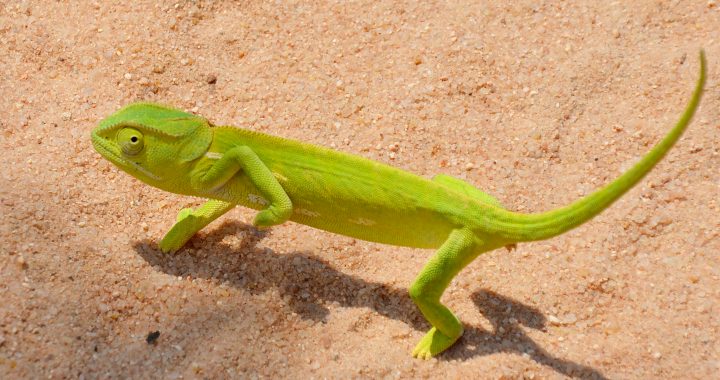
Chameleon carefully crossing the Road © Carina Crayton WHWF

They are a protected species in South Africa - it is not legal for them to be kept without a permit. The road to Sun City outside Rustenburg in South Africa is well-known for illegal selling of wildlife, including chameleons. One should never buy any wildlife offered for sale, as it only stimulates trade, and contributes to extinction. The correct thing to do it to report it to the SPCA who does regular raids on the known trade areas. That is the best chance for these animals to go back into the wild. Sadly, the flap-necked chameleon is in high demand for the international pet trade, being the third most highly traded chameleon species. More than 111,000 individuals were exported between 1977 and 2011, mostly to the USA. Coupled with habitat loss, these figures end up decimating the natural populations.

As with so many of Africa’s vibrant wildlife, superstitions about Chameleons abound. From the idea that they shoot lightning from their eyes, to the belief that they are immortal – these beliefs do very little to protect the species. They are feared and hated among by some people, regarded as a bad omen by others. The only way to fight against this misinformation is to educate people. For instance – the belief that they are immortal, and that chameleon babies are formed by the bones of a dead chameleon, might stem from their habit of digging a hole to lay up to 60 eggs. In the instance of the Flap-necked chameleons, these eggs only hatch in 9 to 12 months, when the hatchlings will dig themselves out of the hole. If the mother didn’t survive, it would surely seem as if the babies came out of her ‘bones’.

When threatened these chameleons will inflate themselves, open their mouths and hiss. They are ready biters too, but although painful, the bites are not venomous. It is no wonder that the word chameleon is the Latinized form of the Ancient Greek khamaileon.  The word derives from khamai (on the ground) and leon (lion) and translates loosely as ‘ground lion’. This refers to the reptile’s intimidating defensive display.

Chameleon survival is threatened by Habitat Loss and Fragmentation, the Illegal Wildlife Trade, Domestic Cats and Natural Predators in the Wild, such as Monkeys and Snakes, Pesticides used in gardens, and Human fear resulting in needless killing.

As with everything wild we would love to protect, the same principles apply: You can help by planting indigenous plants, not using harmful pesticides or insecticides, NOT supporting the Illegal Trade, NOT removing them from the Wild to keep as pets, and Educating people about these tiny, colourful Ground Lions. If you are lucky enough to have a piece of earth to call your own, a more organic lifestyle and gardening habits favour the survival of indigenous wildlife. And maybe, one day, in your own garden, you will find some of these Flap-necked chameleons rolling their eyes at you.

Written by Carina Crayton © Wild Heart Wildlife Foundation

Flap-necked Chameleon easily identifiable via the flap on the neck, and light markings on the flank © Paul Oxton WHWF

Please Share this Article, Page or Post here


Wry Face – Incredible Survival of Giraffe with Malformed Face

Giraffe with Wry Face Congenital Defect Survives to adulthood!

Wry Face or Wry Nose is a congenital condition (birth defect) which affects certain species of animals, and is most obvious in species with long faces, such as horses and cattle. The condition is normally associated with a cleft palate, which makes suckling a huge challenge for the new-born animal. Depending on the severity of the malformation (slight <5° to severe >60°) lateral deviation, many animals do not make it to adulthood.

It is common for animals born with this condition to have the upper jaw and nose deviated to one side, usually causing the nasal septum (the cartilage plate that separates the right and left nasal passageways) to be deviated as well. This can result in breathing difficulties due to obstruction of the airway. Wry nose is most obvious in species with long faces, such as horses and cattle.

An animal with Wry Face / Wry Nose may have poor alignment (malocclusion) of the teeth and may have difficulty taking food up into their mouth and chewing food, which can lead to uneven wearing of the cheek teeth. Obviously, this could also lead to the animal becoming emaciated and dying. The chances of survival are better once they pass the suckling stage, as animals are incredible resourceful; and their ability to adapt in order to survive is impressive.

It is rare for a wild animal with Wry Face to survive to adulthood. The giraffe pictured here, was spotted and photographed in South Africa’s Kruger National Park by Adele Sneyd, in October 2020, near Shingwedzi.  According to Sneyd the animal seems healthy and well-adapted to her condition.

On the left, the Giraffe spotted in October 2020. On the Right, the skull of a Horse with congenital Wry Face clearly shows the extent of the deviation.

You have to admire the tenacity and sheer will to survive visible in wild animals with this deformity, against all odds. Nature will find a way to look after her own.

Written by CJ Carrington ©Wild Heart Wildlife Foundation

Please Share this Article, Page or Post here


Paradise is closing down – Fracking and Oil Drilling in Okavango Delta

The ghastly spectre of oil drilling and fracking in fragile Okavango Delta

For a distance of some 150km, Canadian company ReconAfrica’s oil and gas prospecting concessions border the Kavango River, a crucial source of water in a semi-arid area and the lifeline for one of Africa’s greatest concentrations of wild species in the Okavango Delta into which it discharges.

The fate of one of Africa’s most valuable ecosystems may depend on results from wells being drilled deep into the bedrock beneath the Kalahari of northern Namibia and Botswana in the hunt for a petroleum reservoir.

If the search by Canadian oil and gas company ReconAfrica is successful, the region could be irrevocably transmogrified by networks of access roads, truck traffic and heavy machinery, pipelines, drill rigs and hundreds of oil and gas production wells.
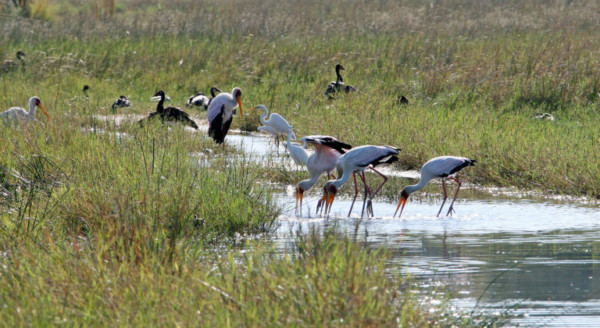
A group of yellow-billed storks and other birds feed on small fishes in the flooded grassland in the Kwedi concession of the Okavango Delta, about 30km north of Mombo, Botswana. (Photo: EPA / Gernot Hensel)

For ReconAfrica it would mean “the largest oil play of the decade” and immense financial profits. For social and environmental justice activists it spells unmitigated disaster.

The role played by the Namibian government (a 10% shareholder in ReconAfrica’s Namibian exploration concession) is of grave concern. While the petroleum company is vocally proclaiming that they are on the brink of a major discovery, the Ministry of Mines and Energy (MME) is downplaying potential risks and suggesting that the focus is merely on “exploration”.

Does this mixed messaging suggest misinformation on the part of ReconAfrica to lure potential investors? Is the government trying to obfuscate what’s really happening in the region? Is this then a case for the US Securities Exchange Commission to investigate?

ReconAfrica holds exploration licences for an area of more than 25,000km² in north-eastern Namibia and a further 9,900km² across the border in Botswana. Beneath this land lies the Kavango Basin, a geological mega-structure which the company’s experts conservatively estimate to contain 120 billion barrels of oil equivalent.

To put the claimed size of this deposit into context, the largest oil field in history, Saudi Arabia’s Ghawar Field, is believed to have held a total of 88 to 104 billion barrels of oil, while the country estimated to have the biggest proven reserves is Venezuela at about 303 billion barrels.

A group of giraffes in the Kwedi concession of the Okavango Delta. (Photo: EPA / Gernot Hensel)

In a press release, the MME suggests that the “necessary environmental impact permits” are in place, but opponents question the efficacy and thoroughness of the process and argue that ReconAfrica’s environmental impact assessment (EIA) falls short of legal requirements.

One major concern is that the exploitation of oil or gas deposits may require the use of hydraulic fracking technology, which involves injecting pressurised, water-based, chemical-laced fluid into wells to help release hydrocarbons tightly held in so-called unconventional deposits.

The myriad dangerous effects of fracking, from its need for vast amounts of water to the potential for artificial earthquakes, the contamination of ground and surface water and the poisoning of humans as well as the natural food chain, are well documented.

In its extremely optimistic communications with the media, ReconAfrica implies that fracking may well be on the cards. Daniel Jarvie, a petroleum geochemist on the company’s technical team, states that its licences in Namibia and Botswana “offer large-scale plays that are both conventional and unconventional”. Such unconventional “plays” would require fracking.

In a 2019 presentation to investors, ReconAfrica compares the Kavango basin to the huge Eagle Ford Shale oil and gas field in Texas and refers to plans for “modern frac simulations”. In the case of the Eagle Ford Shale, fracking at thousands of wells has been linked to air pollution and an increase in seismic activity “33 times the background rate”.

Dr Annette Hübschle of the Environmental Futures Project of UCT’s Global Risk Governance Programme warns that “we should be very concerned about the long-term impacts of fracking on livelihoods, health, ecosystems, biodiversity conservation and especially climate change.”

The MME insists, however, that neither an onshore production licence nor a licence to develop unconventional resources has been applied for or granted. They declare that “no hydraulic fracking activities are planned in Namibia” and that “Recon will not be conducting any fracking activities in the Okavango Delta.”

While the MME seems to imply that what is going on is merely exploration for possible petroleum reserves, ReconAfrica appears ready to move into oil production as soon as possible, noting that once a commercial-scale discovery is declared, their agreement with the Namibian government entitles them “to obtain a 25-year production licence”.

Ultimately, the debate over fracking may be moot as there is little doubt about the overwhelmingly destructive effects of major petroleum production – with or without fracking – in a dry, ecologically-sensitive region.

And that’s without the occurrence of any disasters – an unrealistic expectation from an industry responsible for some of the biggest environmental catastrophes in history, from the Exxon Valdez and Deepwater Horizon to Canada’s tar sands and the devastation of the Niger Delta.

According to Hübschle, “the EIA fails to address the issue of the high volumes of water required for exploration and how the highly toxic and radioactive drill mud will be cleaned and disposed of.”

A threat to people and cultural heritage:

A small herd of zebras in the Kwedi concession in the Okavango Delta. (Photo: EPA / Gernot Hensel)

What is indisputable are the risks to which large, industrialised oil production would expose the region.

For a distance of some 150km, ReconAfrica’s concessions border the Kavango River (often referred to as the Okavango River, and called Rio Cubango in Angola), a crucial source of water in a semi-arid area and the lifeline for one of Africa’s greatest concentrations of wild species in the Okavango Delta into which it discharges.

The region as a whole is home to around 200,000 people. The Okavango Delta, which is downstream from the suspected oil field, provides a livelihood for indigenous populations of at least five ethnic groups who rely on the landscape for water, fishing, hunting, wild plant foods, farming and tourism.

Of particular concern are local San communities whose already threatened lifestyle would be deeply impacted by the arrival of the oil industry. What’s more, the area where petroleum production would occur includes Botswana’s Tsodilo Hills — a Unesco World Heritage Site — which is celebrated as the “Louvre of the Desert” and protects over 4,500 San rock paintings, some of which are 1 200 years old.

Hübschle notes that “very few affected parties were consulted by government and the company. While the company is engaging in a winning hearts and minds campaign, there are many affected people who are deeply concerned about their land rights, ability to farm and derive income from community conservancies.”

A threat to Wildlife and Ecology:

A female leopard rests on a termite hill in the Kwedi concession in the Okavango Delta, (Photo: EPA / Gernot Hensel)

A future Kavango Basin oil field not only poses an existential risk to the Okavango Delta, a Unesco World Heritage Site in its own right — Botswana’s most-visited tourist destination and home to a very large and diverse population of animals, including more than 70 species of fish and over 400 species of birds — but it also directly overlaps the world’s largest terrestrial cross-border wildlife sanctuary, the Kavango-Zambezi Transfrontier Conservation Area (Kaza), which straddles the borders of Botswana, Zimbabwe, Namibia, Angola and Zambia.

A source of millions of dollars of income from sustainable ecotourism, the area protects at least four species on the International Union for Conservation of Nature’s (IUCN) list of “critically endangered” animals, including the black rhino and the white-backed vulture, seven “endangered” species, including the grey-crowned crane and the African wild dog, as well as 20 species listed as “vulnerable”, such as the martial eagle and Temminck’s pangolin.

The region is also known for its extensive network of migration routes for the planet’s largest remaining elephant population. Studies have revealed that these animals have huge home ranges of nearly 25,000km² and roam across vast distances between Botswana, Namibia, Angola and Zambia.

The disruption of migration corridors by a massive new oil industry infrastructure would not just endanger the survival of the elephant population but is likely to increase detrimental interactions with local human communities.

“If full-scale drilling goes ahead”, says Hübschle, “the outlook for Kaza would be grim. Tourists won’t come on safari to look at oil rigs.”

From a global perspective, extracting vast amounts of fossil fuels from the region will exacerbate the ongoing human-induced climate crisis which is itself threatening the survival of the Okavango Delta as a result of decreasing annual rainfall in the catchment area.

In a deeper, geological irony, the rocks suspected of containing the oil and gas reserves of the Kavango Basin were deposited in the Permian Period which came to a cataclysmic end in the most extreme extinction event of the Earth’s history that wiped out 90% to 95% of all marine species and 70% of all land organisms.

Digging up and burning oil from these strata will push us even closer to a new global mass extinction.

In its myopic vision, all ReconAfrica sees in the northern Kalahari is money buried underground.

The Okavango Delta, Botswana. (Photo: EPA-EFE / Gernot Hensel)

At a time when the world’s few remaining wild places need all of the protection we can muster when biodiversity is declining rapidly and when global heating is wrecking the world, it’s the kind of vision that undermines the very foundations of our existence.

If we believe in restorative social and environmental justice, we ought to insist that the international fossil fuel industry funds Namibia and Botswana to keep the oil in the ground, to develop renewable energy systems instead and to safeguard their irreplaceable ecosystems.

Written by Andreas Wilson Spath, Daily Maverick, 15 December 2020

Original article here.

More Articles and Posts by WHWF:

Nothing Found

It seems we can’t find what you’re looking for. Perhaps searching can help.

Please Share this Article, Page or Post here


WHWF Limited Edition 2021 Calendar

Now Available!

Be one of the lucky few to proudly display this beautiful Wildlife Calendar in your Home or Office. Only available in South Africa, printing has been limited to 100 Calendars.

The WHWF 2021 Big 5 Calendar is A3 size, 7 beautiful full-colour pages, Wire-bound with hanging hook. All photographs in the Calendar were taken by Paul Oxton (Founder/Director Wild Heart Wildlife Foundation).

These unique calendars are reasonably priced at R225.00ea (excl. Postage/Courier)

An ideal gift for Wildlife and Nature lover, which also helps to support Wildlife Conservation in Southern Africa. All proceeds from the sale of this Calendar will directly benefit the Wildlife most at Risk.

Be quick! Don't lose out - Order Yours Today!


Limited Edition 2021 Calendar Featuring Africa’s Magnificent Big 5

To Order:

Email (wildheartwf.info@gmail.com) or WhatsApp us on 083 588 3550 (see WhatsApp button bottom right of the screen)

  • Step 1: Tell us How many WHWF 2021 Big 5 Calendars you would like to Order for Family and Friends!
  • Step 2: Tell us who you are and how to reach you (Name, email address and Postal Address) so we can Invoice you! (We will discuss Delivery / Pick-up Options with you!)
  • Step 3: Pay upon Receipt of the Invoice.
  • Step 4. Receive your Calendar from the chosen pick-up/delivery point, and proudly display it on your wall!

More Articles and Posts by WHWF:

Nothing Found

It seems we can’t find what you’re looking for. Perhaps searching can help.

Please Share this Article, Page or Post here


Rare Win for Rhinos – Justice for Poached Animals

South Africa: Notorious Ndlovu Rhino Poaching Gang loses Appeal

Three convicted poachers of the notorious Ndlovu gang failed in their bid to appeal their 25 year sentences.  The High Court in Makhanda (Grahamstown) dismissed their appeal on all counts on Tuesday, 24 November 2020.

Conservationists and Wildlife lovers are celebrating this win for the Rhinos the world over.

In April 2016, Jabulani Ndlovu, Sikhumbuzo Ndlovu, and Forget Ndlovu were found in possession of more than 10kg of freshly cut rhino horn, a dart gun used to dispense the M99 immobilization drug, and a handsaw, still bloody from the latest poaching. Several mobile phones, SIM cards and rental cars were used in the poaching operations.

‘What made these poachers so dangerous is the fact that they used the Veterinary Drug, M99, to dart the rhinos, before cutting their horns off. The drug is not available to the public, and is a strictly controlled veterinary product’, says Paul Oxton , the Founder/Director of Wild Heart Wildlife Foundation, a South African Non-Profit Conservation Organization.

©Paul Oxton (WHWF)

Years after their arrest in 2016 at the Makana Resort, the Ndlovu gang was found guilty in April 2019 following lengthy court proceedings, on 55 charges relating to Poaching and Wildlife Crime. The court sentenced them to 25 years each. They immediately appealed their sentences. They are directly responsible for the killing of at least 13 Rhinos, using the veterinary immobilizing agent M99, to dart the animals and then hack off their horns.  More than 100 Rhinos had been poached using this method over several years, and it is highly likely that they are responsible for all of those incidents. Since the gang had been imprisoned, not a single poaching incident has been linked to M99 use.

‘This kind of sedation is not a full anaesthesia, and the animals were able to feel as their faces were chopped into. Rhinos sedated via M99 are unable to move, but are still fully aware. It incredibly traumatic and is probably one of the cruellest methods of poaching’, Carina Crayton (aka CJ Carrington) from Wild Heart Wildlife Foundation explained.

In carefully orchestrated operations, the gang would pose as wildlife-loving guests at the different Resorts, gather information about the locations of the animals, and then poach the rhinos in the targeted area. They were operating as a highly skilled, resourceful criminal unit.

Although it took justice four and a half years to finally catch up with these criminals, Rhino lovers are thrilled with the overturning of the gang’s sentencing appeal  - stating that it is very welcome news in the fight against rhino poaching.

In the case of the Ndlovu Gang, at least two of the rhinos they killed, were pregnant at the time. This counts as a double loss, but the foetuses are not recorded as additional poached animals in South Africa’s official poaching statistics.

It is not just the dead adult rhinos that form part of the tragedy of the poaching scourge in South Africa. The result of poaching for greed is that many rhino babies end up being orphaned. It is estimated that only one out of ten Rhino Orphans are rescued in time to try and save their lives, after their mothers had been poached.  These babies have usually endured severe trauma for many days, including blows from machetes, bullet wounds, and attacks by predators, and they often end up eating sand which in turn can be fatal. Rehabilitating these orphans is costly and takes many years. Often they just do not survive.  It is part of the on-going tragedy that is Rhino Poaching for their Horns - made of Keratin, like your fingernails.

“Nobody needs a Rhino Horn, but a Rhino” ~Paul Oxton (WHWF)

Justice will not bring back the dead rhinos, but it may act as a deterrent for greedy would-be criminals, and assist in a small way in safe-guarding these national treasures. For now, we have to protect and care for the survivors.

Read more about & support efforts to help raise these Rhino Orphans, by clicking here

Written by CJ Carrington, 25 November 2020 - Copyright: Wild Heart Wildlife Foundation


Nothing Found

It seems we can’t find what you’re looking for. Perhaps searching can help.

Please Share this Article, Page or Post here